Best breakfast of my life in the hotel. Not just a buffet. THE vegetarian buffet. And this is after being treated to the buffet at the 5 star Broadmoor where my brother works as a chef.
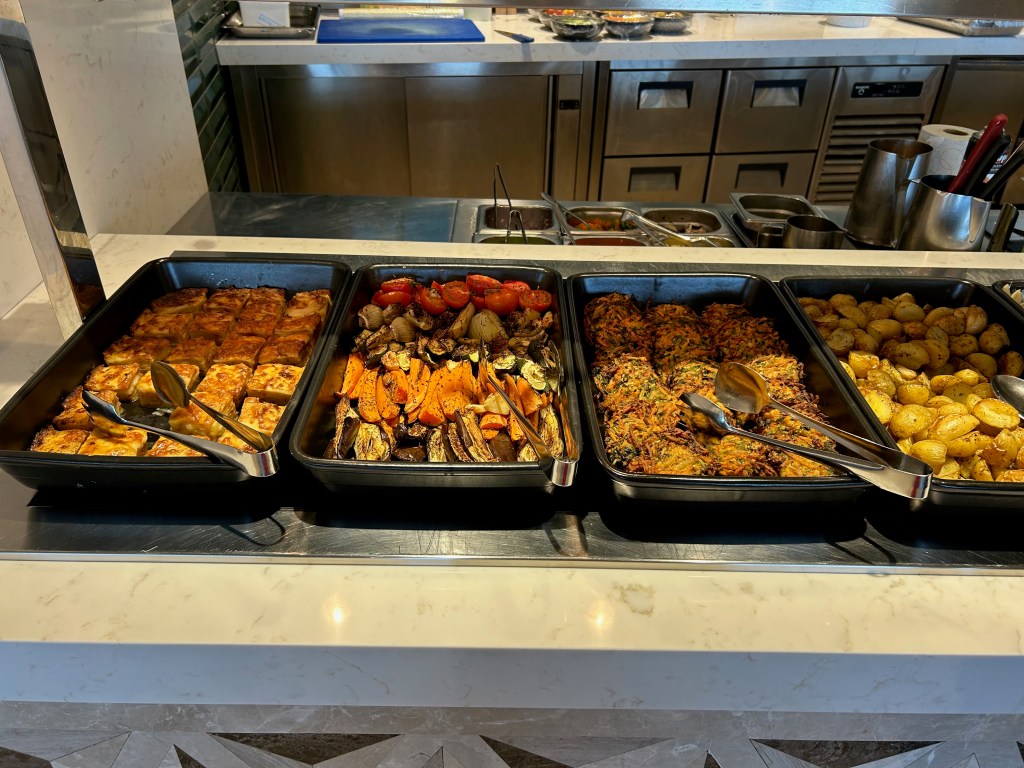
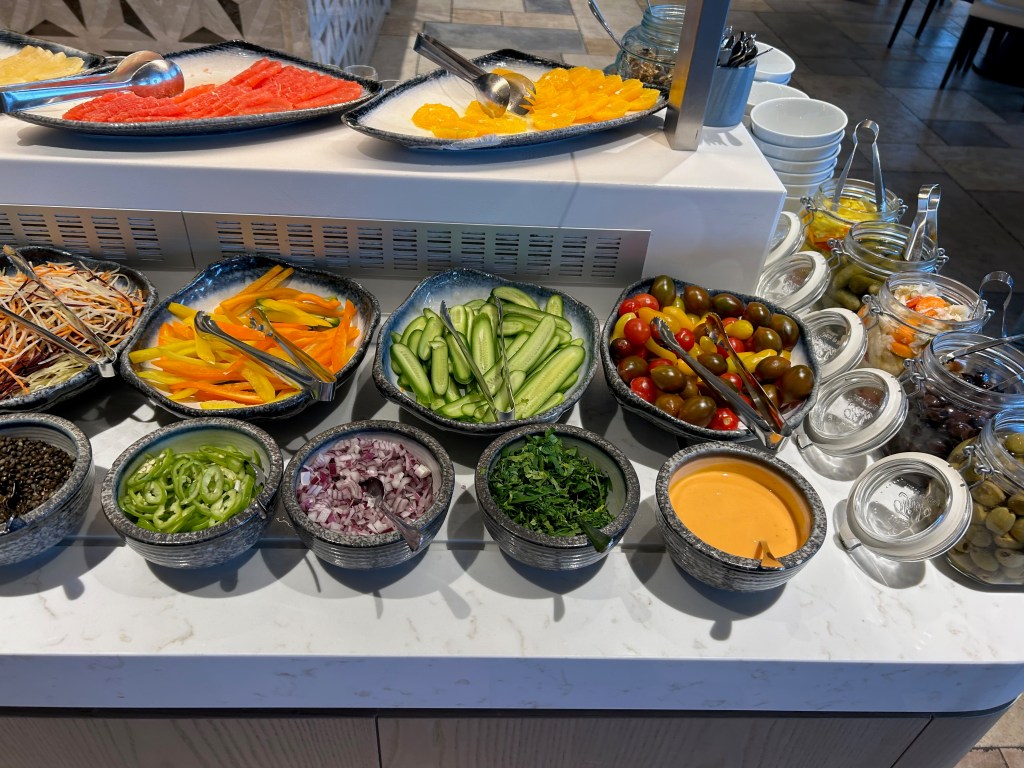
I have lots more photos of the buffet. I’m going to work on a photo journal to expand each of these themes after I finish the blog. Hold me to it!
We had to be on the bus at 7:15am for a 1-hour ride to the border with Gaza.
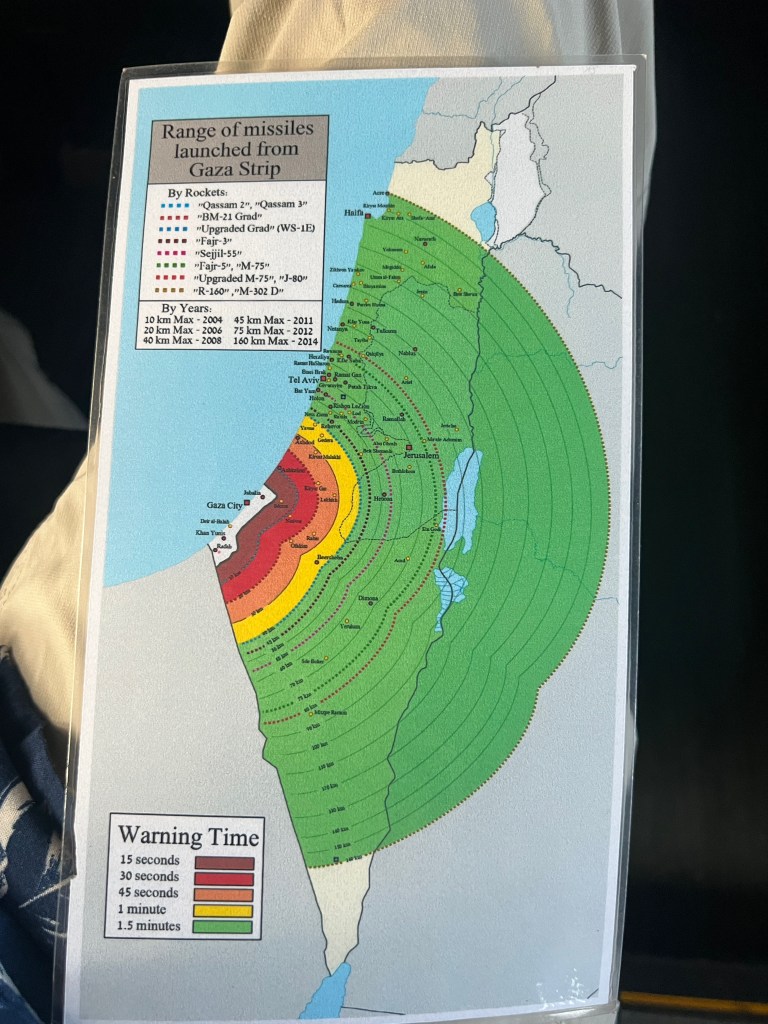
Y. shared a sobering thought. Up until now, we have been in a place where you have 90 seconds to find a shelter during a missile attack from Hamas. We are now en route to a region with a 15-second warning before a missile could hit (either from Syria/Lebanon/Iran in the North, or Gaza in the South).
This is the map of the time it takes missiles to hit based on where you are. We were going to the yellow dot on the brown strip. 15 seconds.
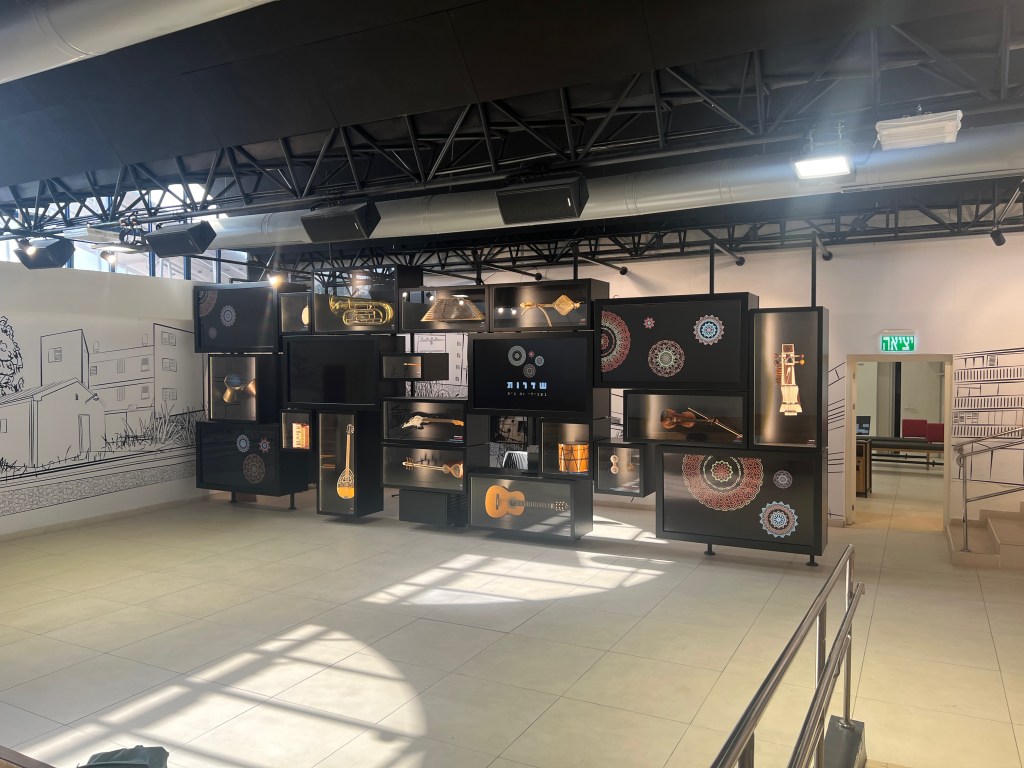
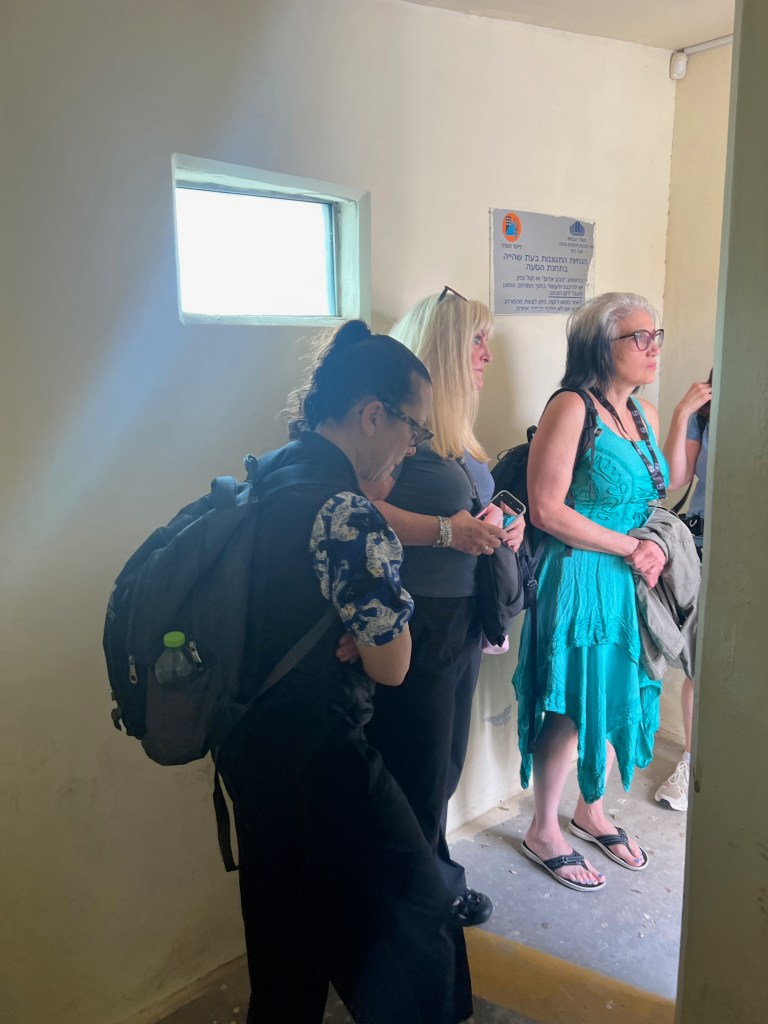
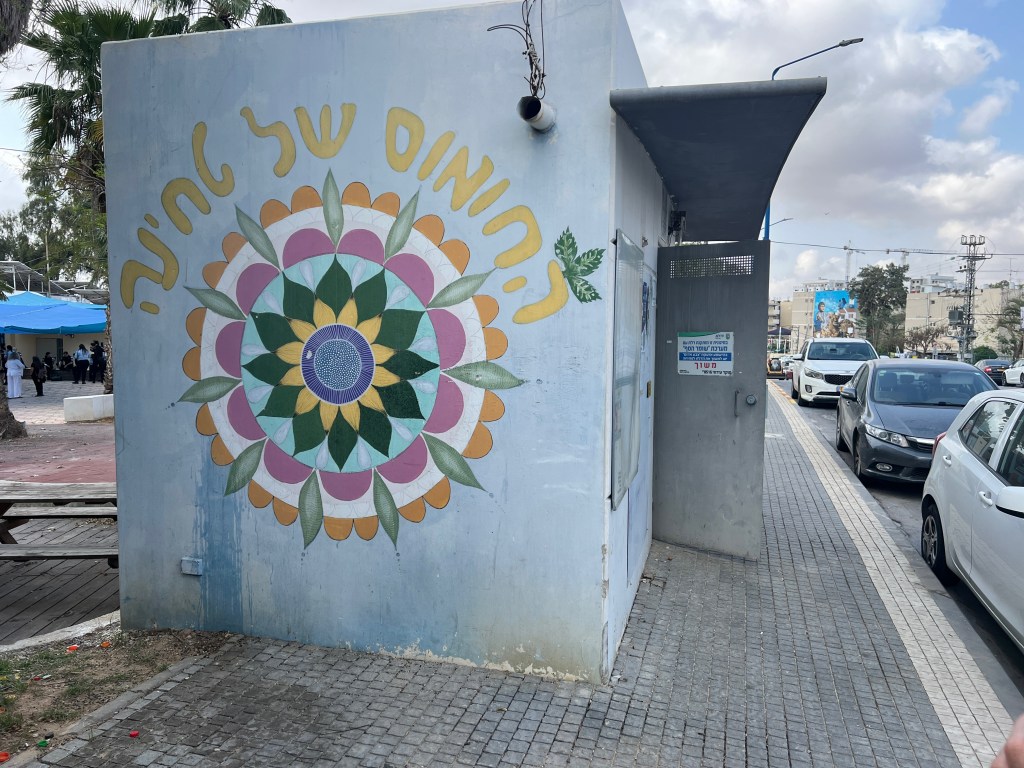
First stop was Sderot. We had a bathroom break in a building that was doubling as a community center/police station since Hamas had blown up the police station on Oct. 7th.
We were then shown the “Safe Room”. This was the first time I had seen one. No bathroom. No water/food.
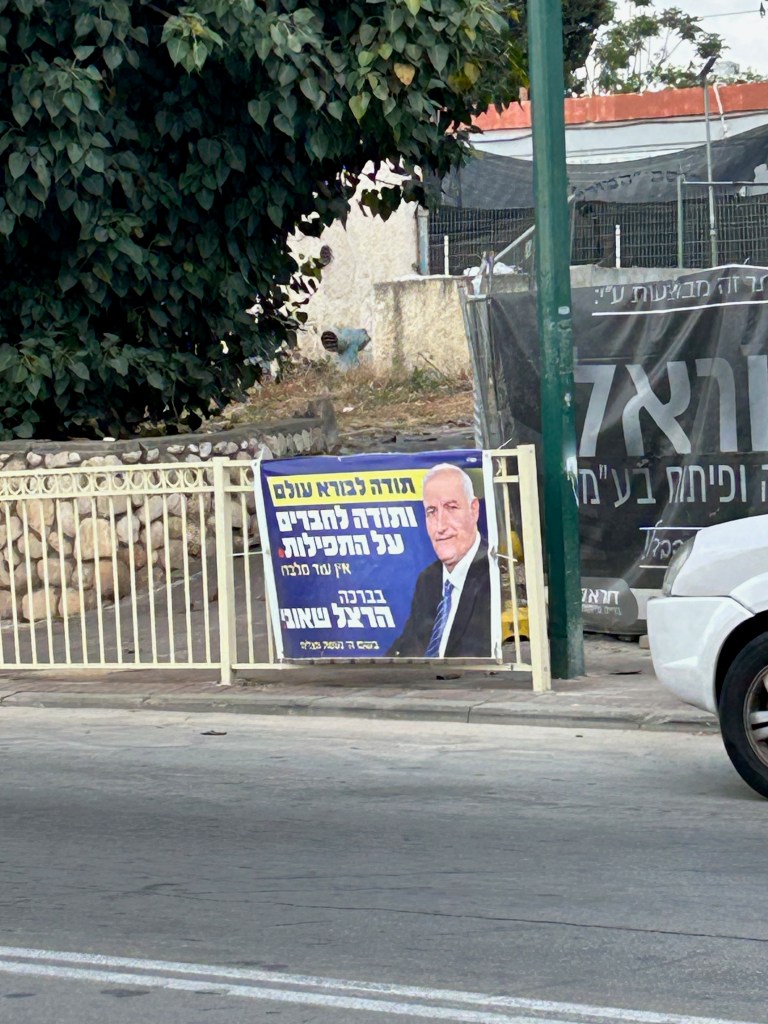
We then met with the Iranian Rabbi of a Sephardic temple. We were told before October 7th he likely would not have met with us, given that he was Orthodox and we were Reform, liberal, just a different kettle of fish. Since October 7th, barriers have come down, everyone puts up the Israeli flag, and there is a sense of community and wanting to be in relationships that did not exist before.
(For those who don’t know, most of the Jews in the US are Ashkenazi, from Eastern Europe. Some define Sephardic Jews as Middle Eastern, or Spanish/Portuguese. In other words, those that fled Spain during the Inquisition.)
(From the internet, although I don’t know if this clears anything up: About 85 percent of the world’s Jews are considered Ashkenazim, the other 15 percent Sephardim. About 10 percent of the world’s Ashkenazim live in Israel compared with about 80 percent of all Sephardim. The Sephardim make up about 55 percent of Israel’s Jewish population and the Ashkenazim about 45 percent.)
The Rabbi shared with us his story of October 7th.
This was the morning of Simchat Torah.
I am going to try to explain the holidays of Sukkot and Simchat Torah for some context. Bear with me.
Starting with the High Holidays, We have Rosh Hashanah, the new year. Fun. Then 8 days of reflection, then Yom Kippur, the most somber day of the year. We fast for 24 hours and hope we will be written in the book of life for another year.
Just when you thought the big Jewish holidays were over and you’d get a break, you build a hut in your backyard or at the temple, and eat (and maybe sleep) there for a week, a reminder of the 40 days Jews wandered the desert. At the end of this second round, there is a joyous holiday called Simchat Torah, a celebration of receiving the Torah. Officially, you re-start the reading. Unofficially, I remember my undergrad days in Hillel in Chicago dancing inside the sukkot, passing around a bottle of peach schnapps and hoping noone dropped the Torah-about the same curse as breaking a mirror.
So it’s early morning of Simchat Torah on October 7th. Around 7am the 69-year old rabbi was walking to the temple to get ready for the Simchat Torah celebration and thought he heard shooting. Hamas terrorists had surrounded the police station a block from the temple and had set up shooters to kill drivers with bullets and rockets.
Hamas killed police officers, blew up the police station. They targeted every car driving past. The Rabbi later showed us a video of some of this, including a woman driver who was shot and killed with her children in the backseat.
Shooting the woman in the car. Shooting at the police. Bombing the police station. We saw an Israeli rescuing the children from the back of the car after their mother had been killed.
He was still trying to make sense of what he was seeing and hearing. He turned to look at what sounded like a stone thrown at the wall, which actually was a bullet, and was shot in the back. He somehow managed to walk to the synagogue and sat down, then called an ambulance which never came.
After a time a friend stopped by the synagogue, also preparing for Simchat Torah, confused by seeing the Rabbi on the ground, not realizing he had been shot. Since no ambulance was in sight, his friend drove him to the health center. Then they got the only bullet-proof ambulance to drive them to a bigger hospital. Hamas was shooting up ambulances, too. That was why no ambulances responded to his initial call.
This is a man who has also served on the local council, had been Mayor of the town.
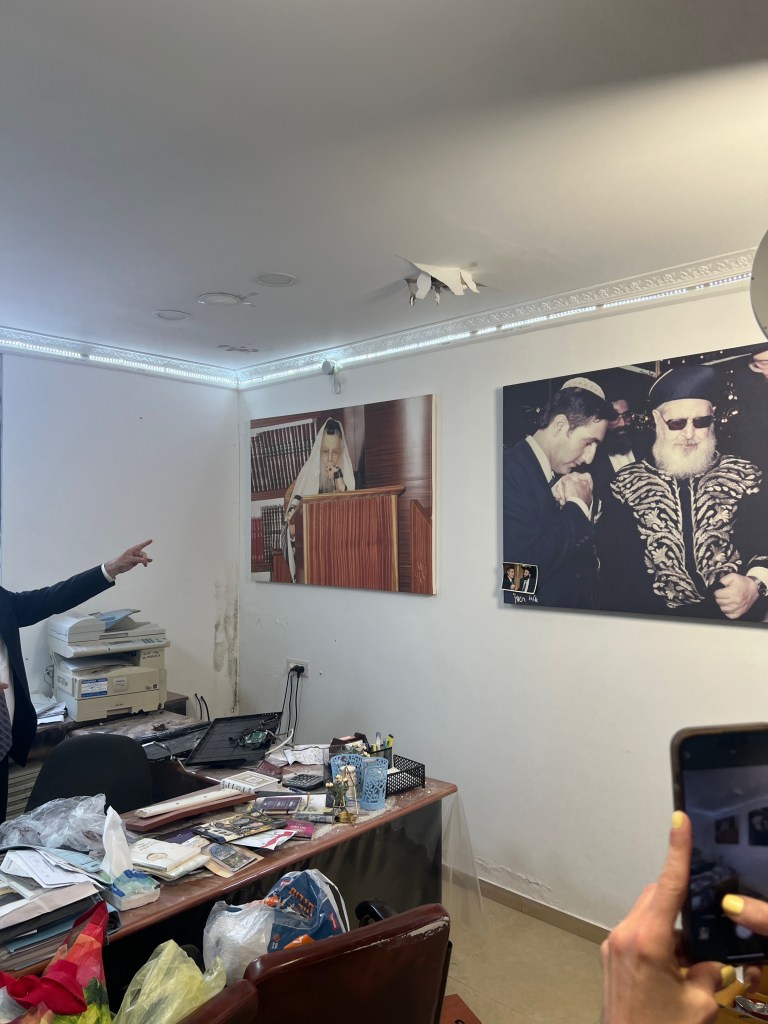
The rabbi showed us his office that had been hit by a rocket, and we saw where the rocket was lodged in the ground. Unexploded. Even after all of the destruction, he said they would likely have to dismantle the office to remove the rocket and he was waiting until after Passover.
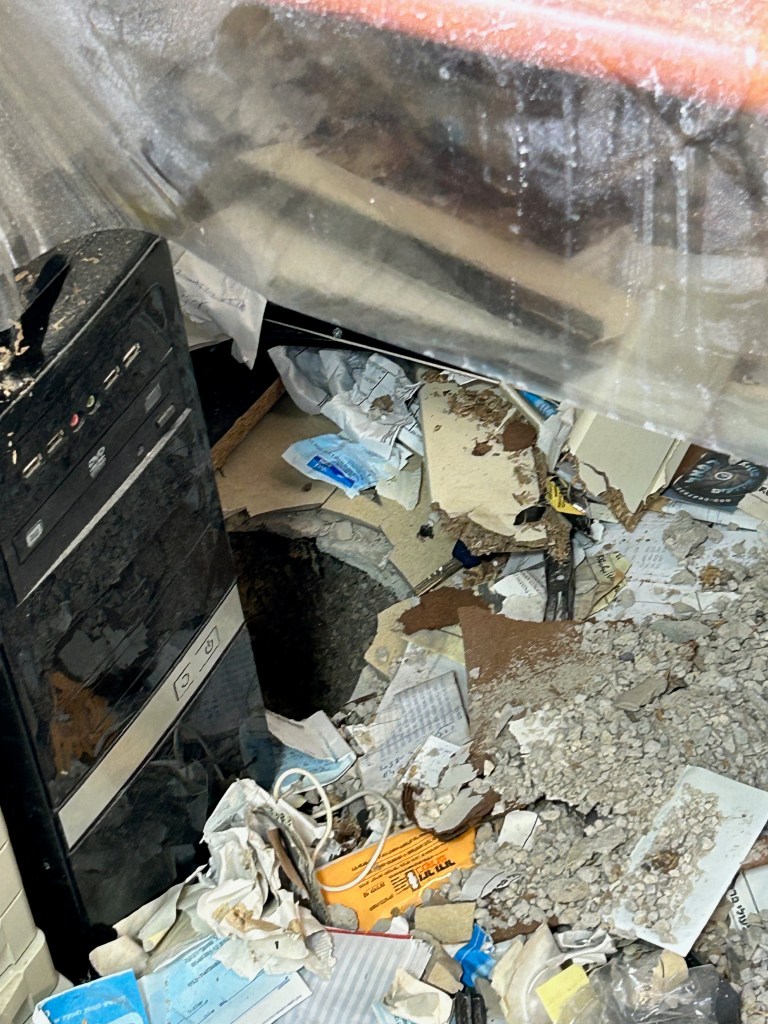
He also observed that they are not suffering from PTSD, they still experience ongoing trauma. Hamas is still firing rockets at them. The other day a rocket landed outside and shattered the windows of the synagogue.
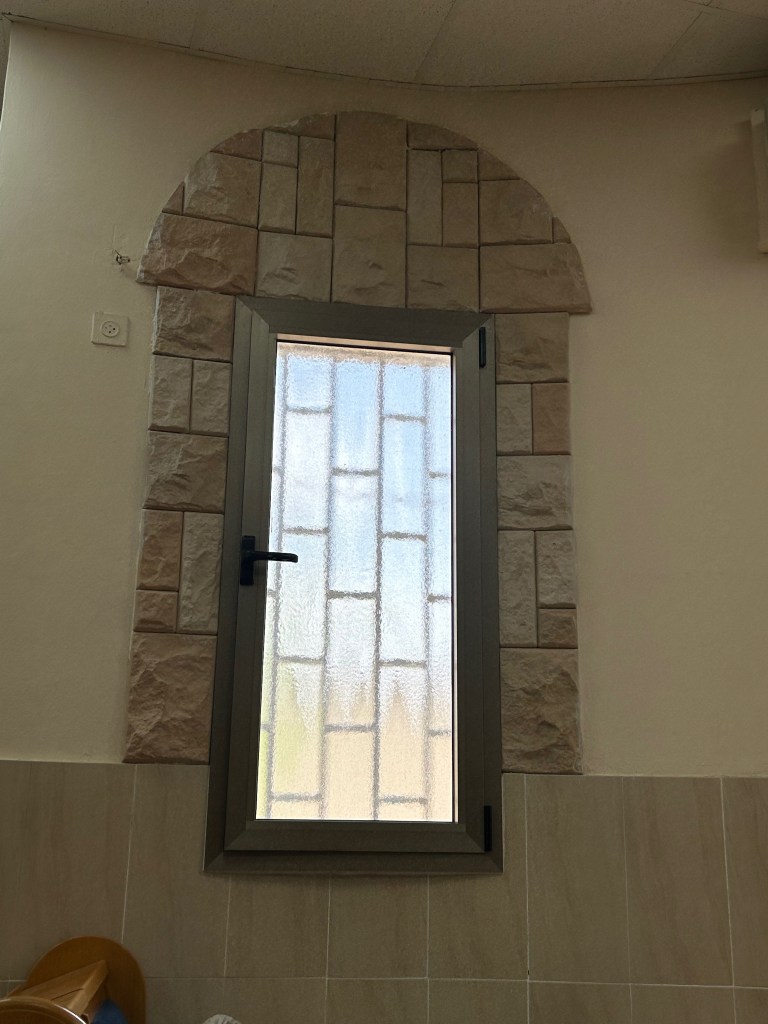
The rocket blast shattered a window like this.
He spoke only Hebrew and our amazing guide Y translated.
But the rabbi was carefully studying all of us.
He suggested that we smile more.
There is a celebration of life and community to be had here.
_____________________________________________________
Next stop on our “trip”: Kibbutz K’far Azza
Driving past Gaza city.
It’s so close!
We waited at the gates of the Kibbutz to be let in. Before October 7th, there wasn’t such security.
Now we are only able to go to a kibbutz if we are invited by soldiers or a member of the kibbutz. The members of the kibbutz are wrestling with how to share their story while maintaining their privacy and handling their trauma. People where we are going were victims of the attack. People were kidnapped and murdered, and we are going to their homes, they are opening up their homes. “They realize that this is bigger than them.”
Our host was a woman named “C.”
C shared her history of growing up going to the beach in Gaza, Palestinians taking walks in the Kibbutz. She left the kibbutz for work but returned years later with her son. She wanted to grow up around family. They all lived on the kibbutz-dad, sisters, best friends.
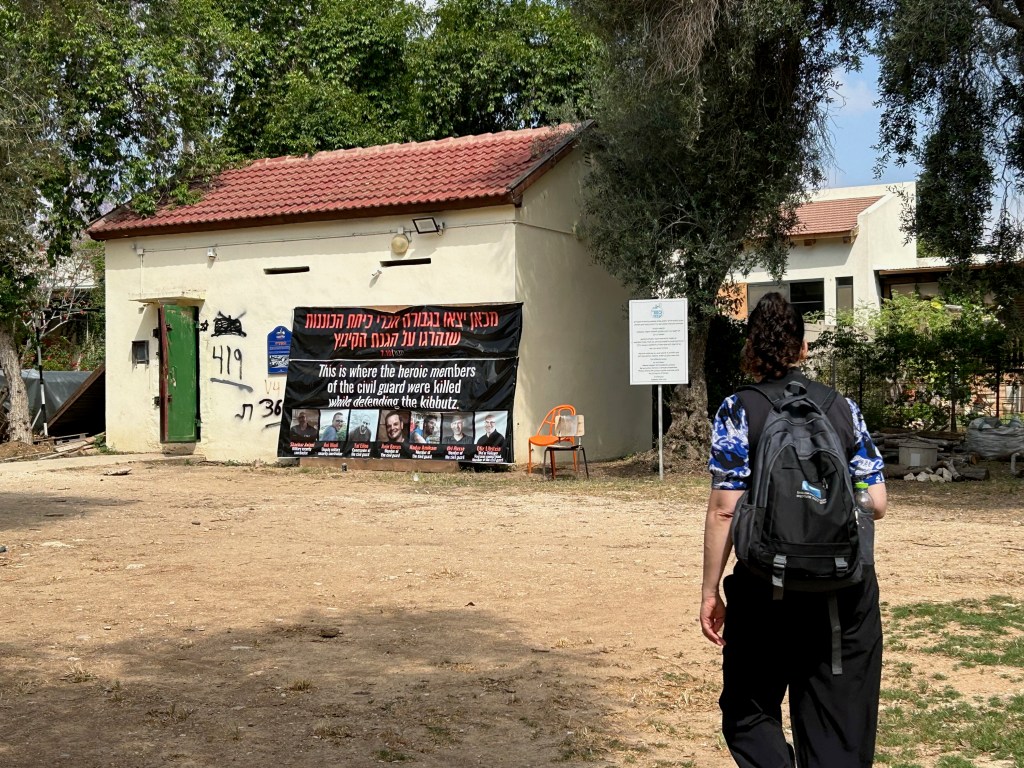
She herself was actually visiting another family member in another country for “the holidays” when the alerts started on October 7th. There is sadly a well-developed phone alert system for rocket attacks.
We sat around her lovely porch table drinking mint water and lemon verbena tea from her garden. Then she showed us the rockets and mortars that had been used to attack the kibbutz long before October 7th.
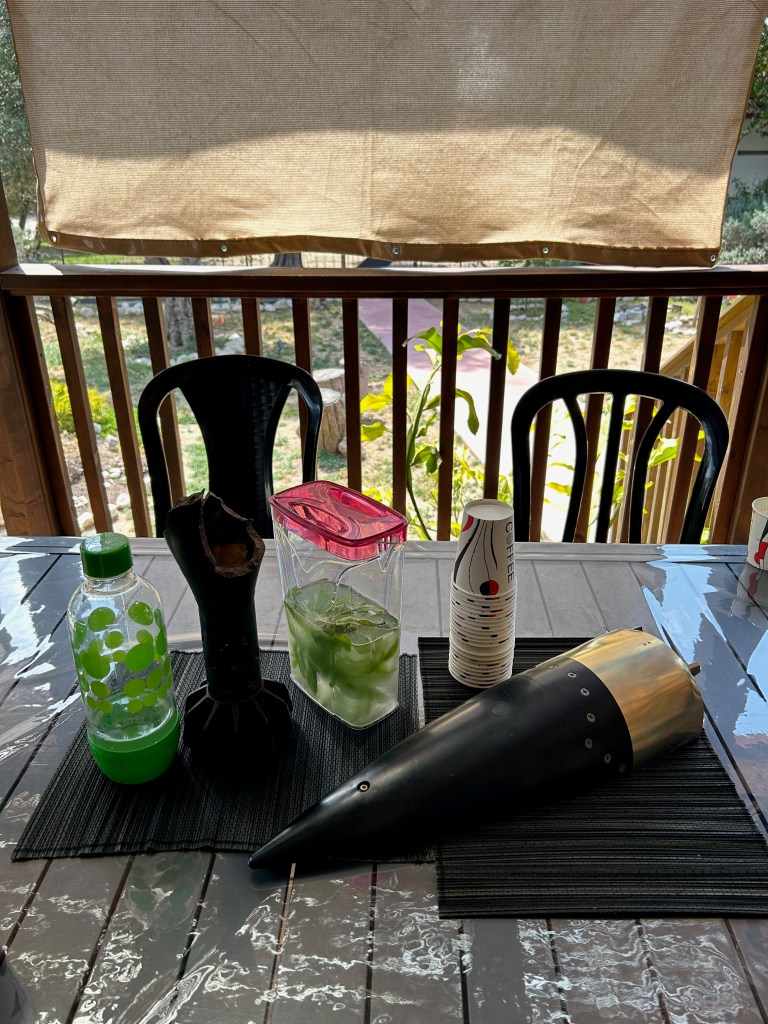
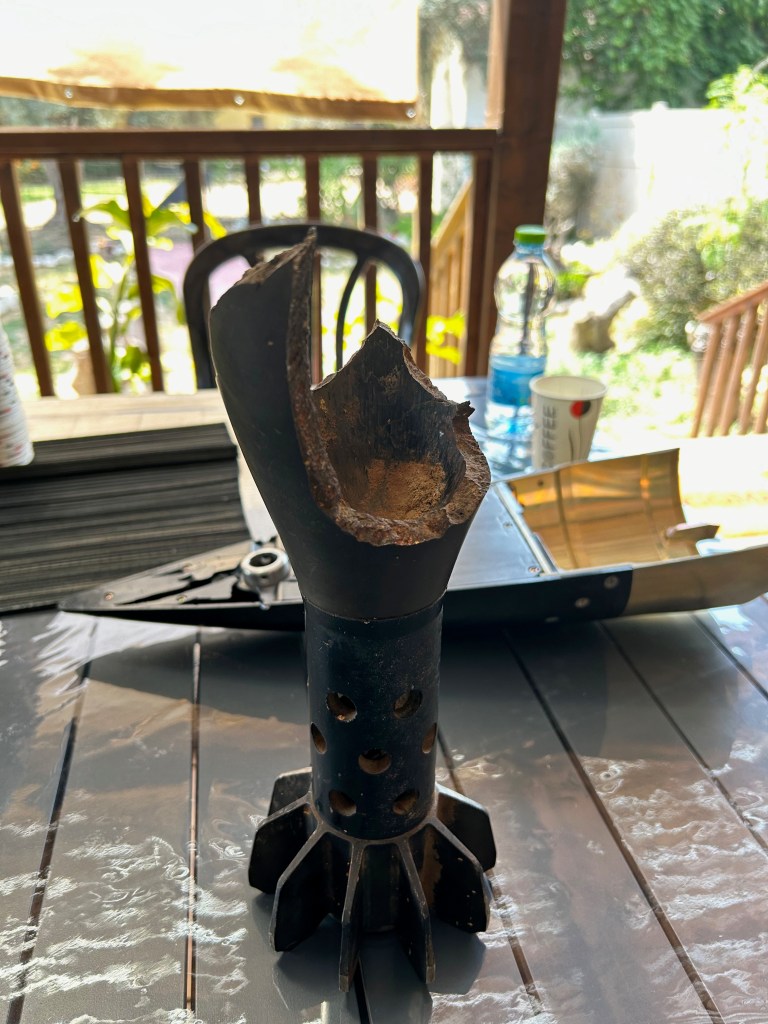
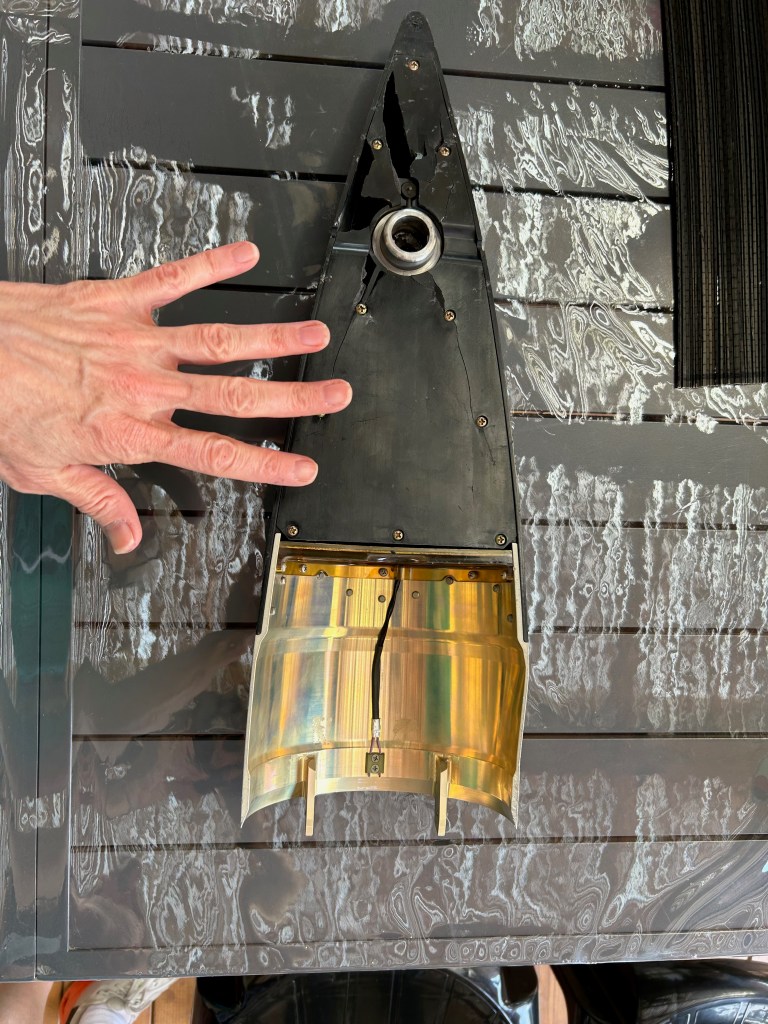
She then pointed to the safe room in her house, and also explained what to do if you don’t have 15 seconds to get there. If you are more than 15 seconds away you just lie down on the ground and cover your head for a few minutes. Israeli children are taught this from the age of 3 years old–Arab, Jewish, Bedouin–all are taught to protect themselves from rocket attacks starting at age 3.
We walked around the fence of the kibbutz and C mentioned that months before the attack Israel had found 34 tunnels built by Hamas that they destroyed. They missed the other 466 kilometers of “tunnels” with offices, cages for hostages, water……Israel also built a billion dollar wall going down 70 meters but intelligence and sensors failed on October 7th. From 2014 and 2016. https://www.timesofisrael.com/netanyahu-lauds-world-breakthrough-in-tunnel-detection/
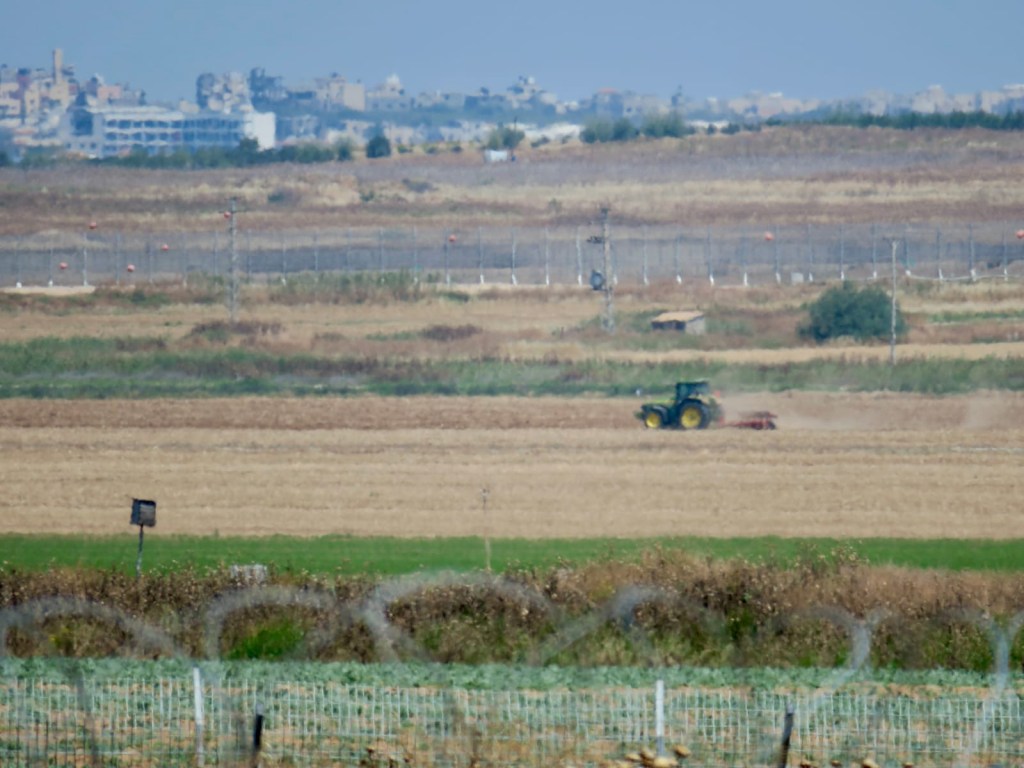
Photo description bottom to top: The kibbutz boundary fence that was breached; kibbutz farmland being worked, even with rocket attacks continuing; the pre-1967 (“green line”) border with Gaza; buildings in northern Gaza; the Mediterranean.
Part of the failure was because Hamas launched thousands of rockets that day as a distraction and partially it was a failure of government intelligence. Hamas terrorists came across the border at 40 locations. They planned this for years. The terror and confusion was made worse because some dressed as IDF soldiers with uniforms and knocked on doors, pretending to be from the army. Before killing people and taking them hostage.
At the kibbutz Hamas knew where weapons were stored and immediately staked out the building to kill everyone who came to the storage room.
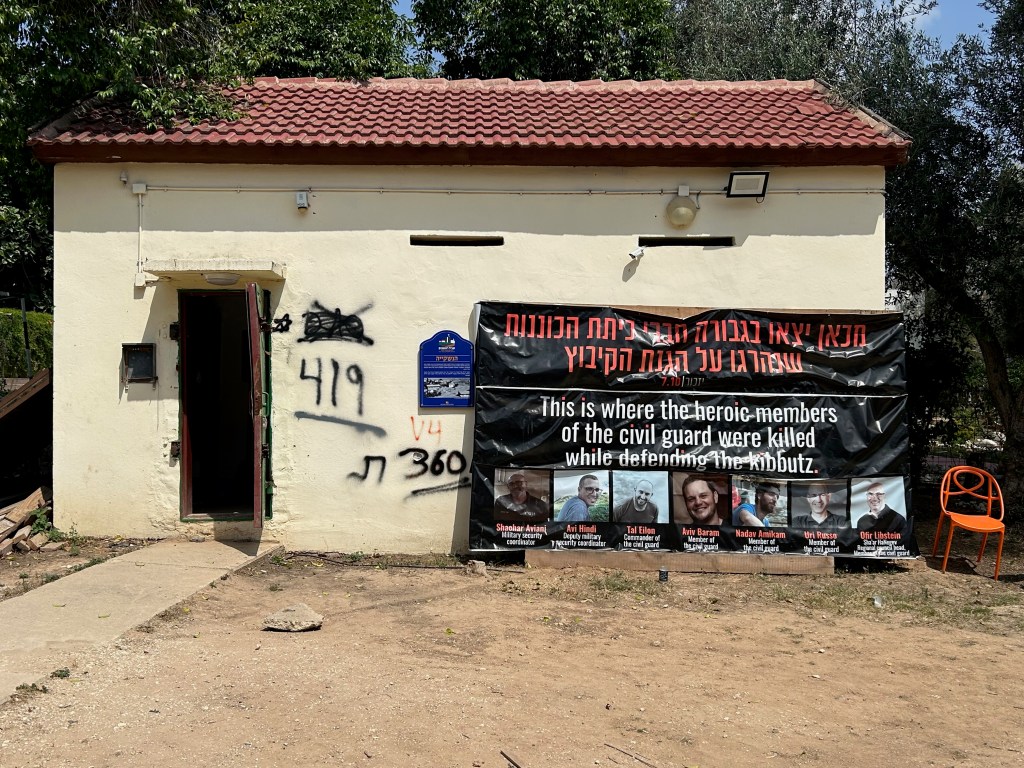
A note about the red and black numbers on the buildings:
A red circle with a red dot indicates a dead body was pulled from the unit. Black numbers can be dates. A black diamond with a ‘C’ inside means cleared.
On October 7th, Israelis learned the flaw with their “safe houses”. These cement square blocks were built to protect from rockets but the doors did not lock. They could be opened from the outside so that rescuers who came to dig them out after a rocket blast could open the door. They were not constructed to protect them from terrorists trying to break in.
We walked around the kibbutz seeing the remains of fire, battered walls, bullets in walls, items incinerated from grenades and bombs.
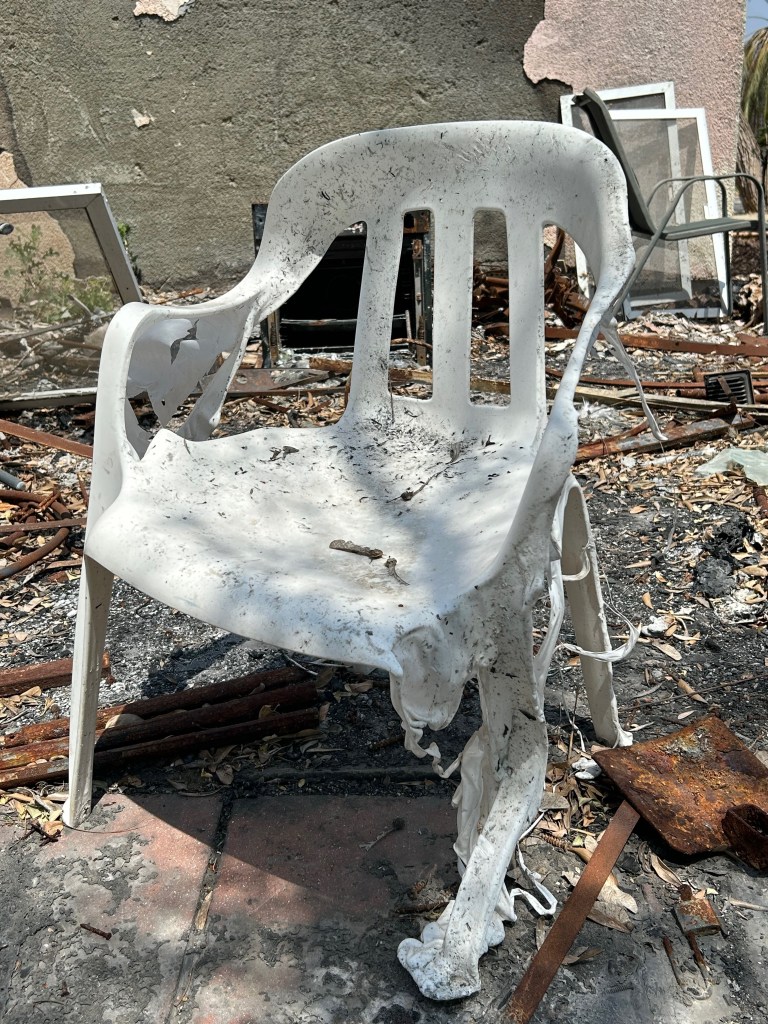
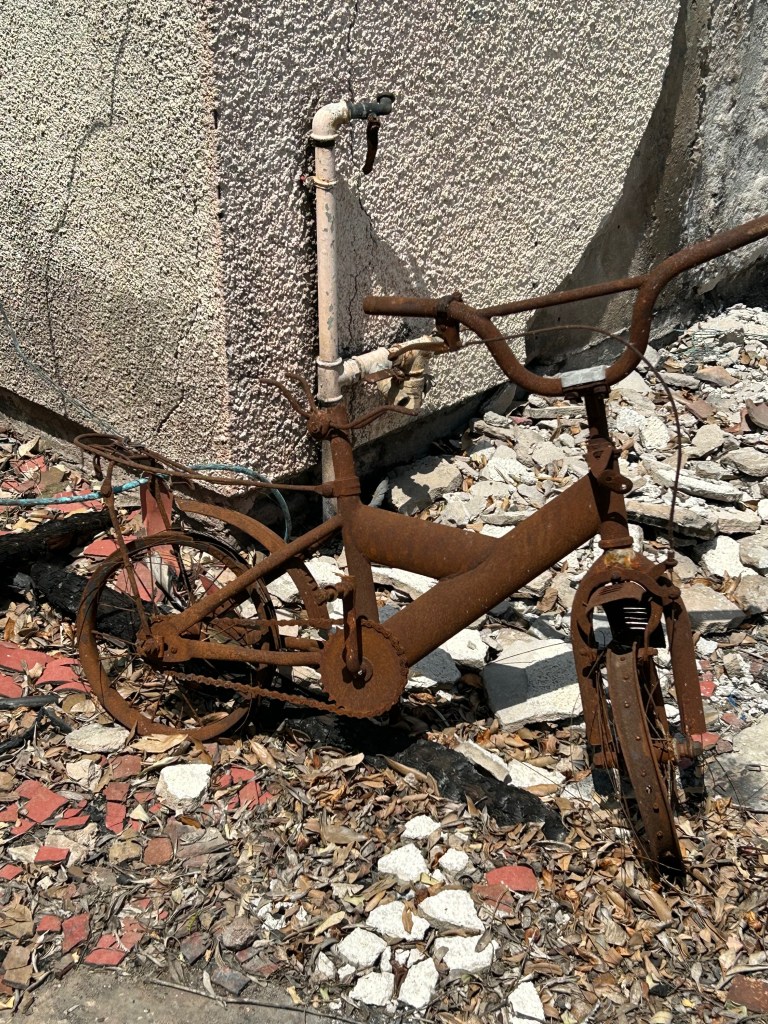
One Sukkah from October still stood.
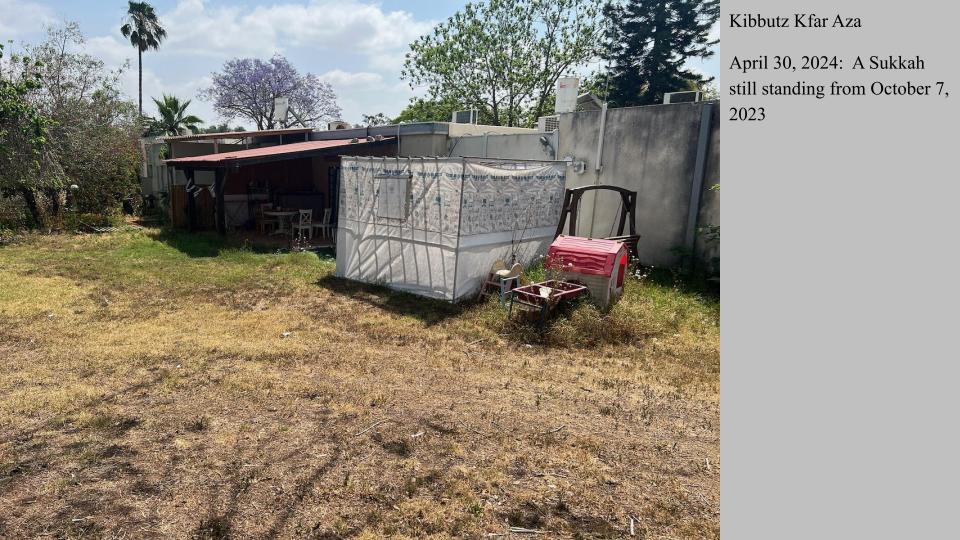
The fighting lasted for three days in a space of a few acres.
One of the saddest things was the young adult section. On this kibbutz there are homes built as one bedrooms–each with a safe room attached–lined up facing each other in rows with areas in front for hanging out. Kids come back from college and live there for a few years “until they figure out life”. It’s the cool neighborhood of the kibbutz. It’s also the closest to the border with Gaza. It’s where terrorists struck first. And it’s where many people died, homes were destroyed, and hostages were taken.
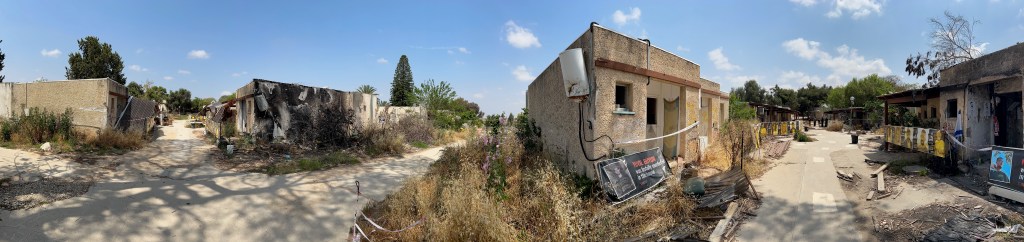
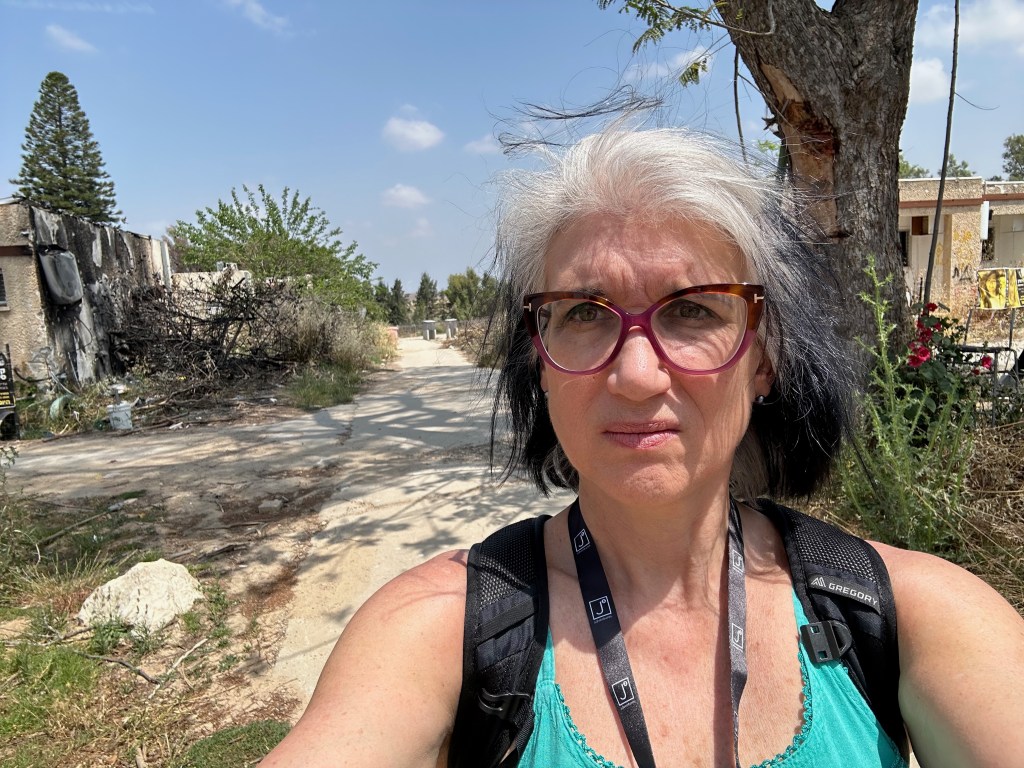
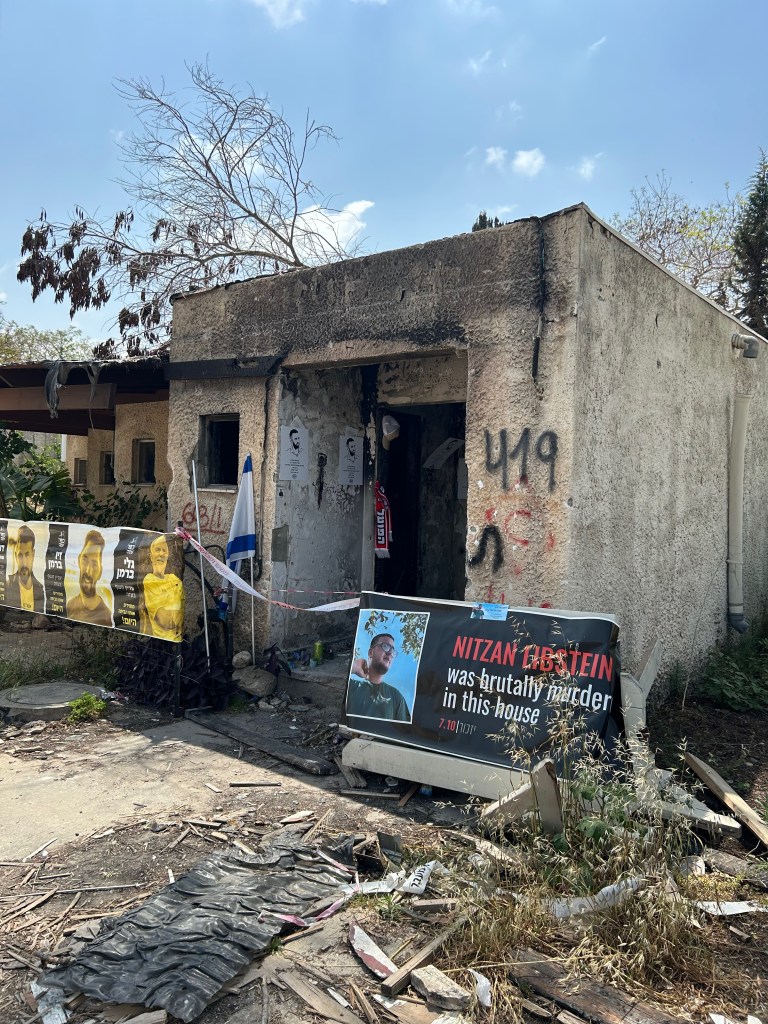
People’s things were being boxed up. 70,00 people in Israel are now refugees, most from the north because of Iran’s rockets and missiles.
C’s sister was hosting 3 other adults and 8 kids during Simchat Torah. At the start of the attack they all went into the safe room. Her sister’s group held the door closed with their hands but they began losing strength and running out of water and air after 12 hours. Somehow C got a message to family soldiers fighting in Sderot (remember the rabbi?) and someone leading a tank brigade there was able to go to the kibbutz and rescue her sister and then return to keep defending people in Sderot.
So much anger at the Israeli government for failing to respond for seven hours. So much appreciation for those who helped, even giving their lives to save others. One kibbutznik was able to warn a nearby kibbutz of what was happening and enabled them to protect themselves before he lost his life. He also helped C’s dad get to safety.
The planning and plotting by Hamas was a study of terror. Other terrorist groups are learning from their strategy. Hamas somehow learned the details of the kibbutz. From photos on social media. From Palestinian neighbors walking their dogs on the border. They had years to plan.
C wants peace. With Palestinians. She wants a deal to bring the hostages home. “Both of us are here to stay. Both of us deserve a good, safe, decent life.”
They measure their community health by how many babies they are having. Just before the attack they were going to build two more baby houses. There were about 900 people living on the kibbutz.
C is now the only one who has returned to live there, joined by a few soldiers guarding the kibbutz. 63 people were murdered, 19 taken hostage, 5 are still being held hostage.
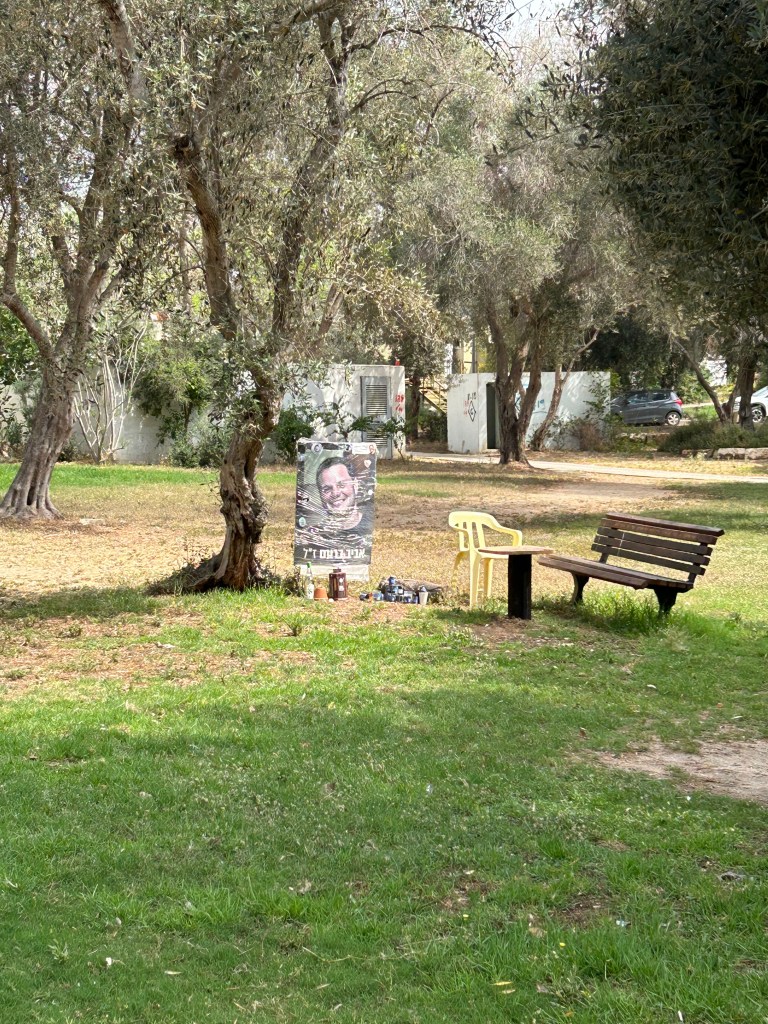
Third Stop, Day 2/5
The site of the Nova festival massacre
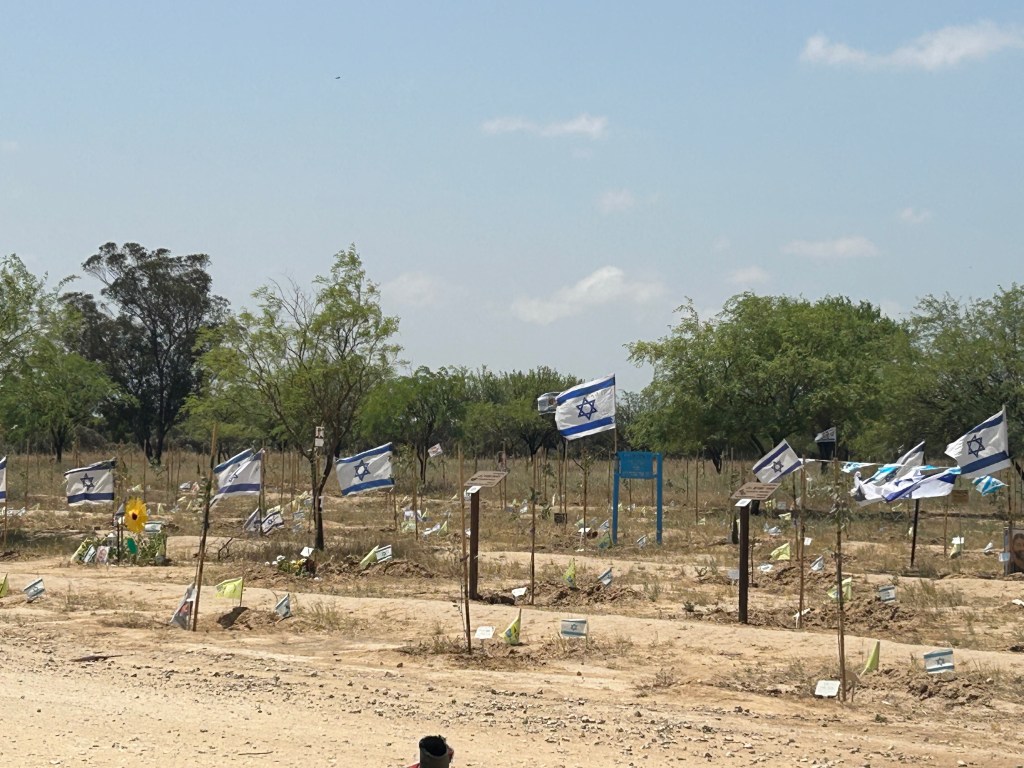
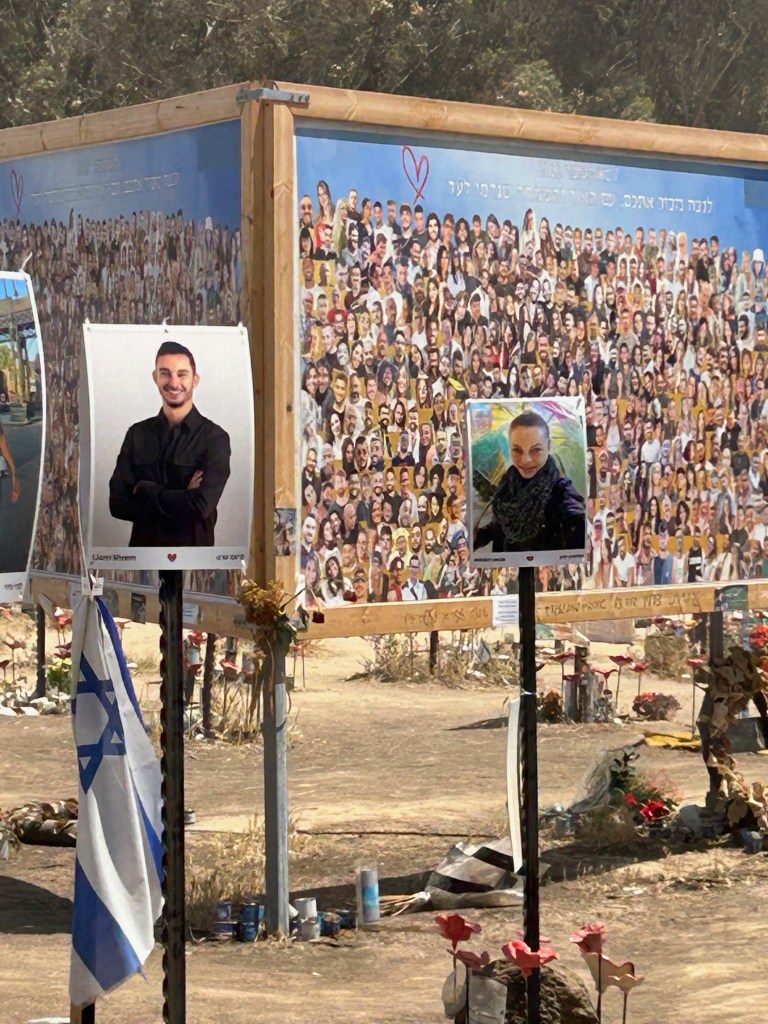
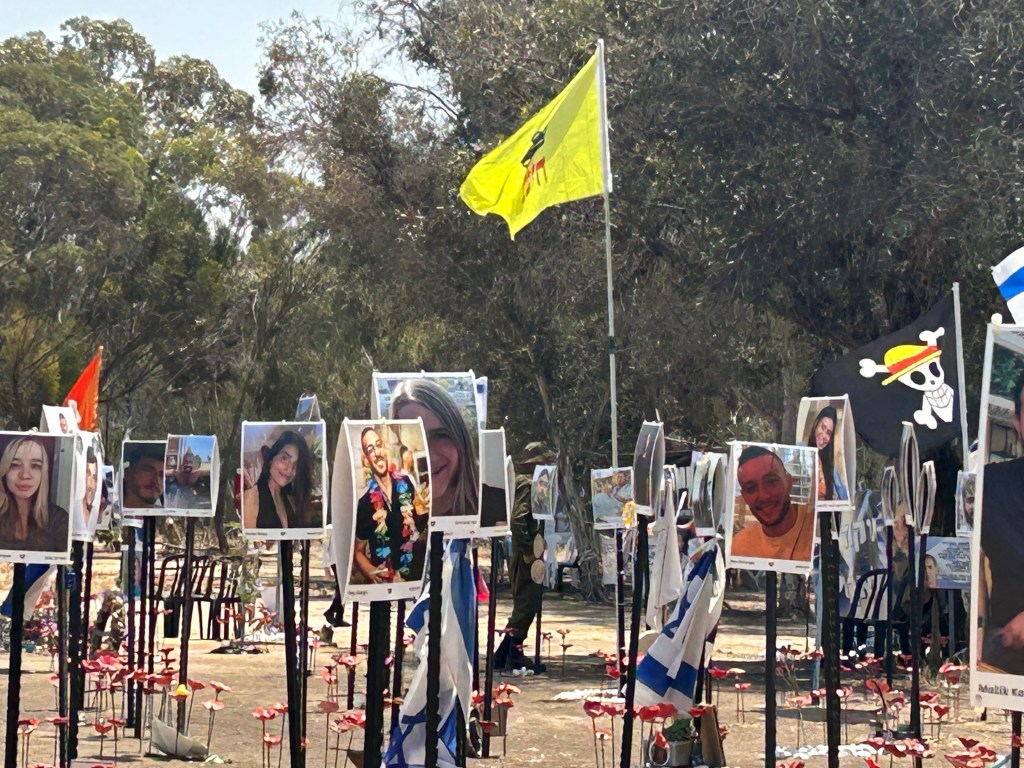
Terrorists shot people dead as they were running and driving away, some hiding in ditches and drainage canals and getting shot like monkeys in a barrel.
Our guide Y first had us gather together. He distributed laminated cards with the story of a group of four people from that day. It’s hard to process the stories and terror of 300 people, but he wanted us to see the world from the vantage point of one group of people. The harrowing account of being there at dawn to celebrate and then realizing something was terribly wrong. Trying to figure out how to escape when all avenues were blocked by terrorists shooting at them. Splitting into two pairs, by luck finding an escape route and then going back into the terror to try to save their friends. Praying their whatsapp would work to find the location of their friends.
Y also gave us a laminated card with the words to Hatikvah, the Israeli national anthem which means The Hope.
We noticed there was an old man playing the saxophone seated near the memorial installation. Our guide is the best in Israel, often spontaneous and improvising our days. He asked us if it was OK to go over and ask the man to say Kaddish and sing Hatikvah with us. Perhaps he had lost a family member and might or might not want to pray with us.
Turns out, the man was also a tour guide. He didn’t have a personal, direct familial connection to someone who had been massacred, but he comes here twice a week to play sax for his soul. It was beautiful and heart wrenching to say Kaddish and sing Hatikvah at the site of the Nova massacre.
Video of us: https://drive.google.com/file/d/1m0LJOE_uW4gJT28ledR0DgH8W5qObF76/view?usp=sharing
Additional resource:
https://www.imdb.com/title/tt31160267/
Lunch
Another improv by our guide Y. He told us we were stopping by a pop-up where people had started making lunch for soldiers and people from the community affected by the massacre. Perhaps we would help cook, maybe it would be too late, maybe it wouldn’t be there at all. Turns out they were no longer there, so we stopped at a gas station-rest stop-food court type place.
We had choices…Shwarma, McDonalds, Pizza, or Aroma–the Israeli version of Starbucks. I had a delightful salad with Bulgarian shredded cheese, no dressing, and an iced soy cappuccino.
Talked to our guide about why he became a vegetarian. At age 6, he doesn’t remember but his mom says he saw a cow killed on the kibbutz and made the choice. My story when I was 12 is reading about how veal is produced. Not so different.
End of the first half of day 2.

 A better future
Leave a reply to Elisabeth Dubin Cancel reply