Today is Shabbat, so no ride today. Lots of text today, not many photos. You have been warned.
Our schedule is:
- Yoga or Services
- Torah service
- Presentation about Cross Border Environmental Cooperation and Jumpstarting Hope/Humanitarian aid in Gaza
- Small group discussions with Arava students
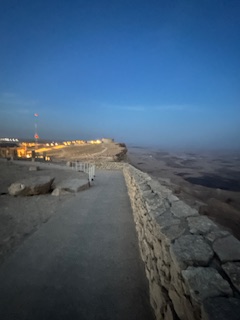
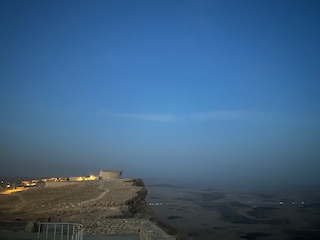
- Havdalah service at the edge of the crater
Jackie enjoyed yoga led by a crew member.
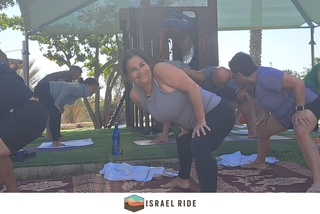
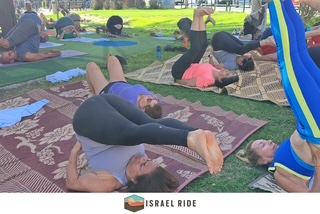
An aside: I am not sure we ever mentioned that the 30 people supporting our 110 person bike riding group are almost entirely alumni of the institute. So in addition to the fact that they are amazing support on the ride, they are also fascinating to talk with-many of them have a masters or are working on a PhD in public health or environmental sciences, engineering, renewable energy, etc.

To refresh your memory, this guy recruited me to read Torah and then to serve as second Gabbai.
He said the job of Gabbai is to “make sure the readers know where they are” which I took to mean point the beginning of the section for the 6 other readers. Oh Nooo. What it means is I am supposed to have printed out all 7 sections, read through them, and then, while they are reading, keep track and provide them with words and melodies if they get confused as well as indicating the end of every sentence. Just FYI, there were literally about 500 sentences in the portion. And I found this out last night.
Up until that time I was worried that I didn’t get all the melodies right. Now I had 500 additional things to worry about.
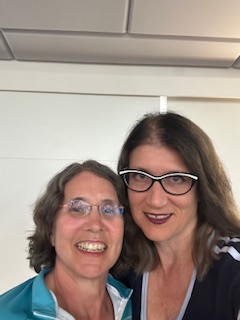
Long story short, it was fine, I did the job well, and Linda Sue, the Cantor from Massachusetts who read the longest portion thanked me profusely after and said I was the best Gabbai she had had.
Presentation about Cross Border Environmental Cooperation and Jumpstarting Hope/Humanitarian aid in Gaza:
Information about the inaugural conference can be found here https://arava.org/first-annual-cross-border-environmental-cooperation-conference-at-the-arava-institute/
I am sharing my copious notes from the talk, since I believe that many of you, dear readers and donors, would like to hear more detail about the work of Arava in the past 9 years and also the current work on the ground in Gaza.
Launched in 2016. The Institute invited experts in resource management and people connected to government who speak the same language of the environment. In 2017, a group of Palestinians who had come to the conference reached out and said they liked what Arava was doing and wanted to be partners. Their organization is called Damour or Date (like the fruit, not the verb to meet up). One of their members had been in an Israeli prison. Another partner of the organization had been a leader of the first intifada and had protested while she was pregnant, and miscarried after being arrested. In jail, she came to realize that Israeli mothers and Palestinian mothers want the same thing–peace. She has dedicated her life to find ways to build peace.
The director of the Institute at that time founded the Joint Implementation Committee of Arava and Damour, with an emphasis on implementation. They didn’t want just talk, they wanted to focus on things they can do. From 2019-2022 they brought to Gaza 7 atmospheric water generators with coordination and support of the Israeli Army. Why? Much of the water in Gaza was undrinkable, and over half of residents in the West Bank were without sewer systems. They focused on potable water for Gaza and waste water treatment in the West Bank. In Israel, 95% of wastewater is treated and can be reused for agriculature. They began working with the Palestinian Water Authority in Ramallah and Jericho to help treat the wastewater and make it useable for agricuature rather than dumping into polluted wadis.
In October, 2023, they had been meeting every other week and had a zoom call scheduled for October 9th, 2023. On October 8th, they asked themselves if they would even be able to look each other in the eyes, and both organizations agreed that this was not the time to take a step back. They needed to look each other in the virtual eye and have difficult conversations to maintain this prescious relationship.
The director who spoke to us said “you can’t stop a war, but we knew we coud position ourselves for the day after the war.” During the war, they focused on helping Palestinian alumni get out of Gaza, including the son of the woman who had been jailed during the Intifada becaue he had been outspoken against Hamas. During the war, people in Gaza had been moved to the south where there were very few resources for refugees. The Arava director sent her $5,000 to help her family get out of Gaza. Instead, she used the money to raise more funds and build the first shelter in the south. She noted that these shelters needed to be sustainable over time, imagining that people were going to be displaced for months or even years.
They coordinated with COGAT (Coordination of Governmental Activities in the Territories), a part of the IDF. They were the first Israeli organization on the ground in Gaza and for one year were the only one. Many international organizations did not want to work with them becaue they are Israeli. They created the Israeli Humanitarian Forum in Gaza. The forum has produced policy papers and submitted them to the IDF and the government. In August 2025, it appealed to the government to ease restrictions on aid, the first time a group of Israeli emergency relief groups had made such a public appeal.
Our group asked questions about how they actually got aid into Gaza, and how they keep it from going to Hamas. The response: they meet Damour at the border to give them aid, and Damour coordinates with elected councils in the refugee camps to distribute aid. They also mentioned there is a screening process for people who come into the camps.
There is much more information about the green shelters, and what Arava and Damour have been doing.
The two partner organizations received permission to build and maintain off-grid shelters for over 20,000 people through their “Jumpstarting Hope in Gaza” project. With the support of international organizations, they are beginning to establish water, sanitation and hygiene (WASH) infrastructure in refugee camps in Gaza. The pilot shelters are already operating in four locations with two shelters in Al-Mawasi, one in Hamad and one in Dir Albalah. Each family is supplied with its own tent within the fenced-off area, where there are communal kitchens and other common services, Abu Hamed said.
This talk was inspiring and also a cold awakening to consider the extensive need for green shelters for hundreds of thousands of people in Gaza over the next few years. Much of what the Arava Institute does is to create sustainable pilot projects with the hope that the international community will help fund, support, and expand their successful efforts.
NEXT EVENT of the day–Discussion circles with graduates of the Institute
For an hour we broke into groups of 8 riders and 2 alumni with a facilitator. In Jackie and my group, there was a Palestinian Arab Israeli woman and an Israeli Jewish guy. The woman talked about the story she was raised with, the Naqba, referring to the Catastrophe of her parents losing their homes in 1947-8, and her grandparents rescuing her parents from a refugee camp in Syria. Her family now lives in a northern Israeli city. She talked about coming to the Institute, and not being as surprised by the Jewish students since she had been at school with Jewish kids, and learned to write her name in Hebrew before Arabic. For her, the surprise was getting to know Palestinian and Jordanian students, presumably because of the complicated feelings about Palestinians becoming Israeli citizens. She is currently getting a PhD in public health, studying recognized and unrecognized communities and their access to electricity and the impact on health in Israel.
The Iraeli Jewish young man talked about how he was raised in a settler family and left when he was 16. He still served in the army, and was upset by combat. After his service, he rejected staying in the reserves, began to travel internationally, and felt like he just wanted to check out and leave Israel. While travelling, he and friends he met started to dream of a different world. He heard about the institute and decided to come study. He attributes his time at the Institute to enabling him to get to know “the other”, so that now, during a conflict, he doesn’t feel like he is on the Jewish side and Palestinians are on the other, but instead, knowing people on both sides makes it harder to believe in a simplified us and them. For him, creating peace and a different future have involved moving to an Arabic-speaking town to learn Arabic with his friends and start a bike repair workshop in Jerusalem to repair old bikes and sell them for cheap, making bikes more acessible. Funny enough, if you remember our blog post from day one, same workshop!
Last activity of the day–Havdalah
This is one of our favorite services. It’s the break between the rest day of Shabbat and the workweek. It involves all of the senses–taste (drinking wine or juice), smell (passing spices), sight (burning candle), sound (singing) and vision+sound (watching the flames burn and dunking the candle into the wine to hear the sizzle). It represents the division between rest and work, but also the reminder to bring rest and peace into the week with all of your senses awake.
https://www.youtube.com/shorts/6kMu-VAWaO4
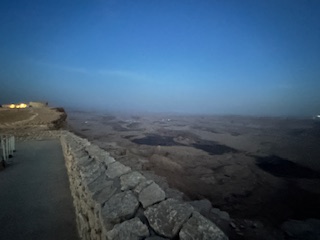
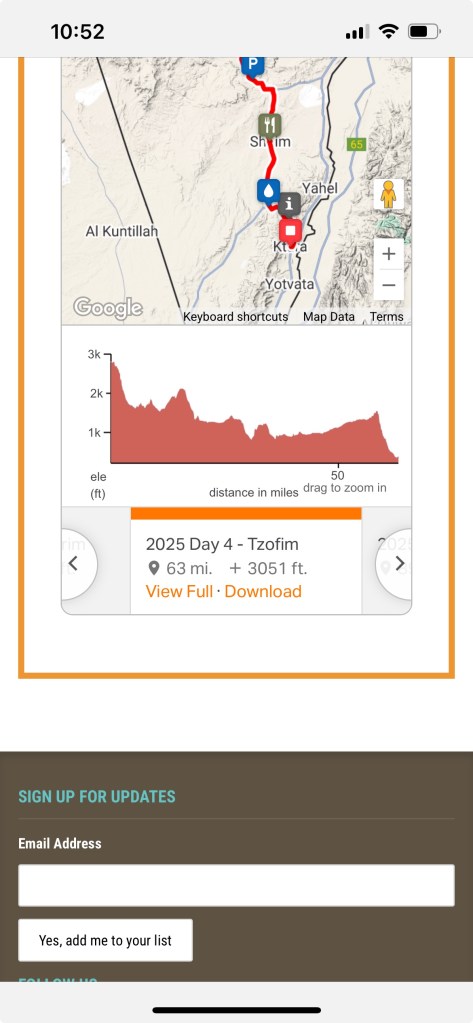
Tomorrow we ride–second to last day of our trip. Two important elements to note-we will land at the Arava Institute and Kibbutz Keturah where it is housed, and … those crazy downhills with some pretty big uphills too. And remember, when your guide says the worst is over, no more hills…don’t believe him. When the guide says we are close to a rest stop, don’t believe him.
Love,
Sarah and Jackie
 A better future
Leave a comment