Today was full of hope and expectation, interspersed with a few concerns and doubts about the huge downhill at mile 6 tomorrow, and late-night news about renewed fighting.
There are three different riding groups among the 110 participants. Chicago Boss Girls (you can also find us on instagram) is in the second group, TZOFIM.
You can find our daily itinerary on the website here: https://israelride.org/the-israel-ride-experience/itinerary/
Tzofim will be bused to the outskirts of Jerusalem, for the launch ceremony. The morning route will start with a long downhill from the Jerusalem hills, passing a few small communities in the area with one short climb. Lunch will be at Luzit. After lunch, the route heads west towards the Mediterranean coast, ending with a ride through the port city of Ashkelon.
DISTANCE: 55 miles, 2200 feet climbing (670 m climbing) (of course they don’t mention the descent. My mom pointed out that we are leaving from 800 meters descending to sea level).
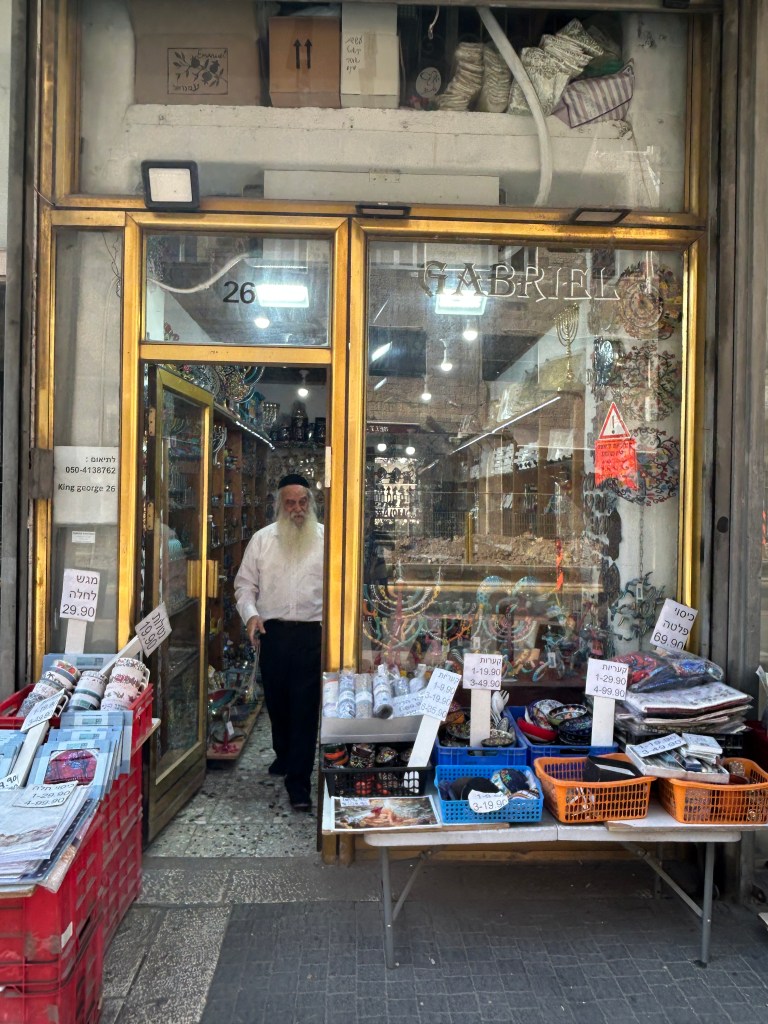
Jackie and I hit the gym this morning to stretch and work on our core, then squeezed in a visit to a book shop and secured art and kitchen mementos including glass from the Chagall window. I promised the owner we would share information about his shop, selling primarily Israeli-made items. As he mentioned, he has been waiting two years for people like us to re-appear.
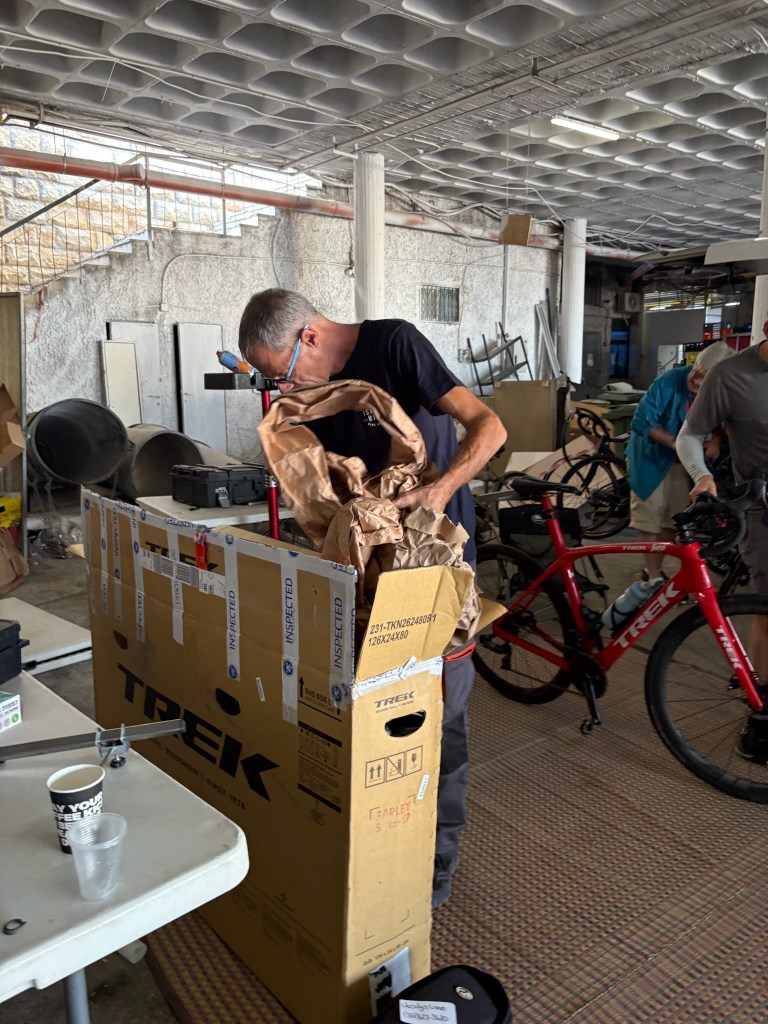
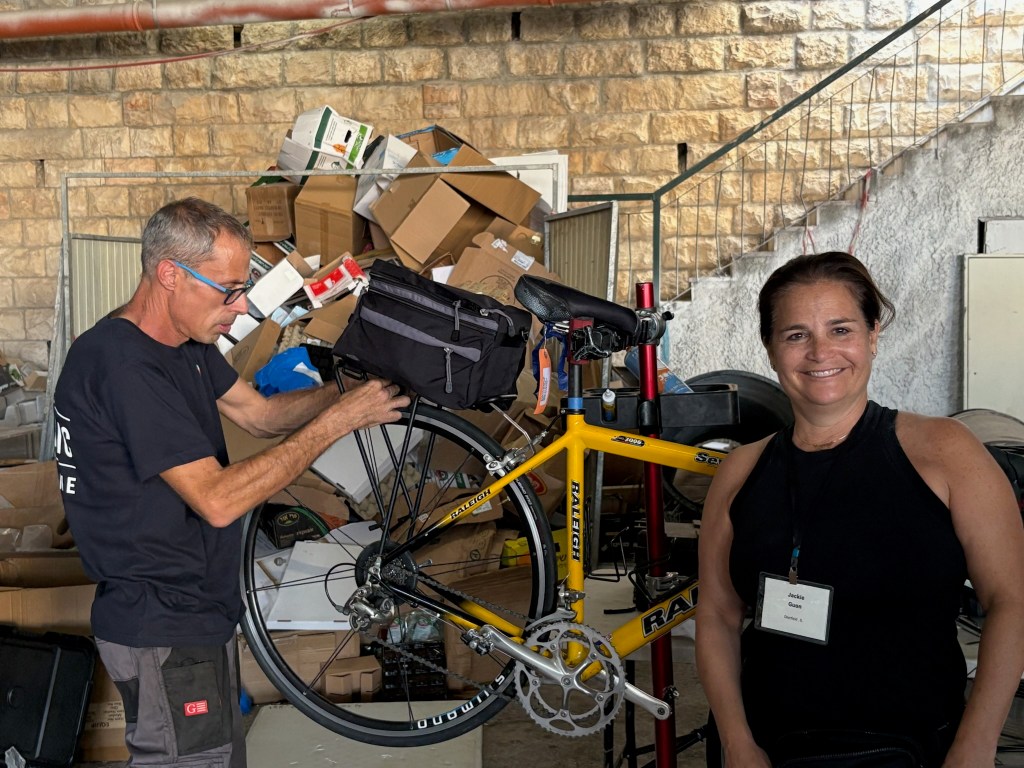
We made our way to Bike Central at the Brown Hotel. There we collected our bikes (remember the small white SUV that somehow whisked them away Sunday? It now made them magically re-appear), headed to have them reassembled, and rode for a short, traffic-ridden ride through the outskirts of Jerusalem to test all gears and breaks before labeling them and kissing them goodbye until morning.

Our first official meeting was an optional women’s orientation. Out of 110 riders 30 are women. Surprisingly, Jackie and I were among the youngest riders. Most women were between 55 and 75 years old, and many had done the ride multiple times. In the lat few years, due to COVID and the war, the ride had been cancelled numerous times. This year is particularly special given that so many people had to postpone their first ride, and we were also informed this would be the last year of the ride in its current form. The first ride I believe was 2005.
The women’s orientation consisted of introducing ourselves and discussing our motivations, as well as learning about hydration, pitstops, safety, and undergarments (you’ll have to ask me in person for details).
The next two hours were spent in a group orientation and then rotating among breakouts in our ride group. Lots of talk about hydration, security, and making sure we don’t try anything new on the ride (this is not the time to experiment with how fast you can go downhill, for example). We were also told that we would have an ambulance dedicated to our ride as parts of our journey will include travel through remote areas. As Mom always says, however, an ounce of prevention is worth a pound of cure.
In addition to safety, tips on the road, and dos and don’ts (like be sure to talk with the crew, since they are all volunteers and most are graduates of the Arava Institute, and do not pass people unnecessarily, don’t stop on the shoulder to take pictures, and don’t eat the gluten free food if you didn’t request it.) Re: pictures, they have volunteers taking pictures we can all access and download–we are encouraged to take pictures at rest-stops but not along the road for safety reasons. And in case anyone worries there won’t be enough variety, last year’s ride offered 26,000 photos to choose from!
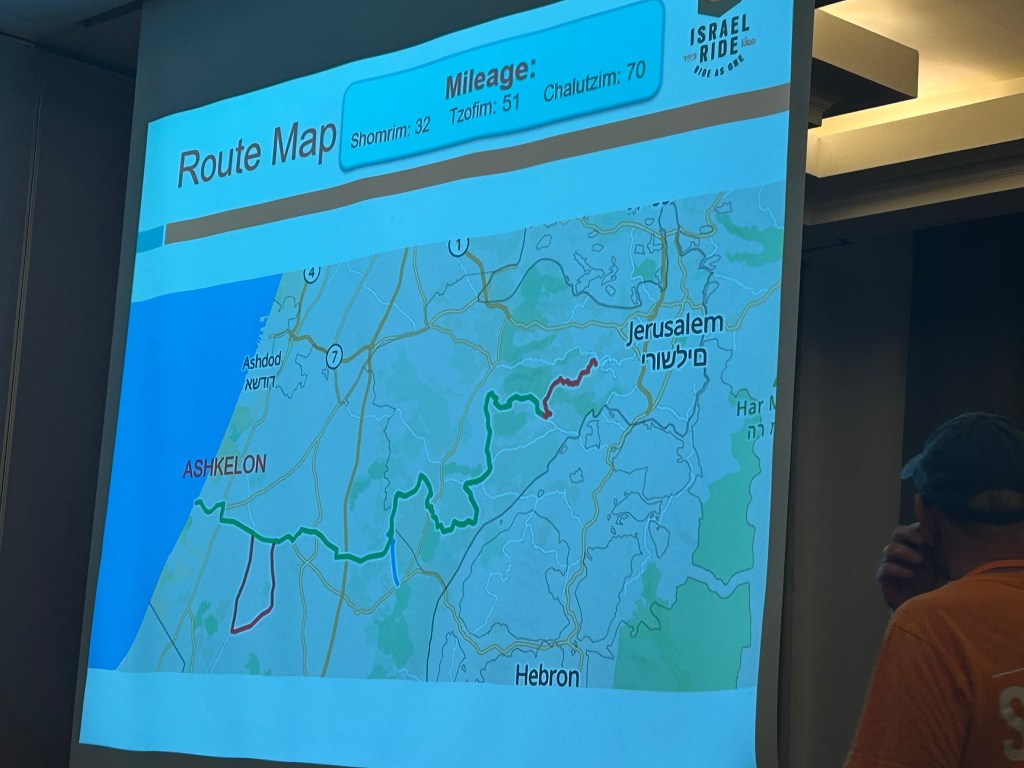
Our route, above
Our final session was hearing from Tareq and Rachel Kalikow, the CEO of Friends of Arava, about the work of the Institute and recent developments. As always, they were informative and inspiring. Tareq gave new examples of some programs and detailed the impact of US AID pulling international funding.
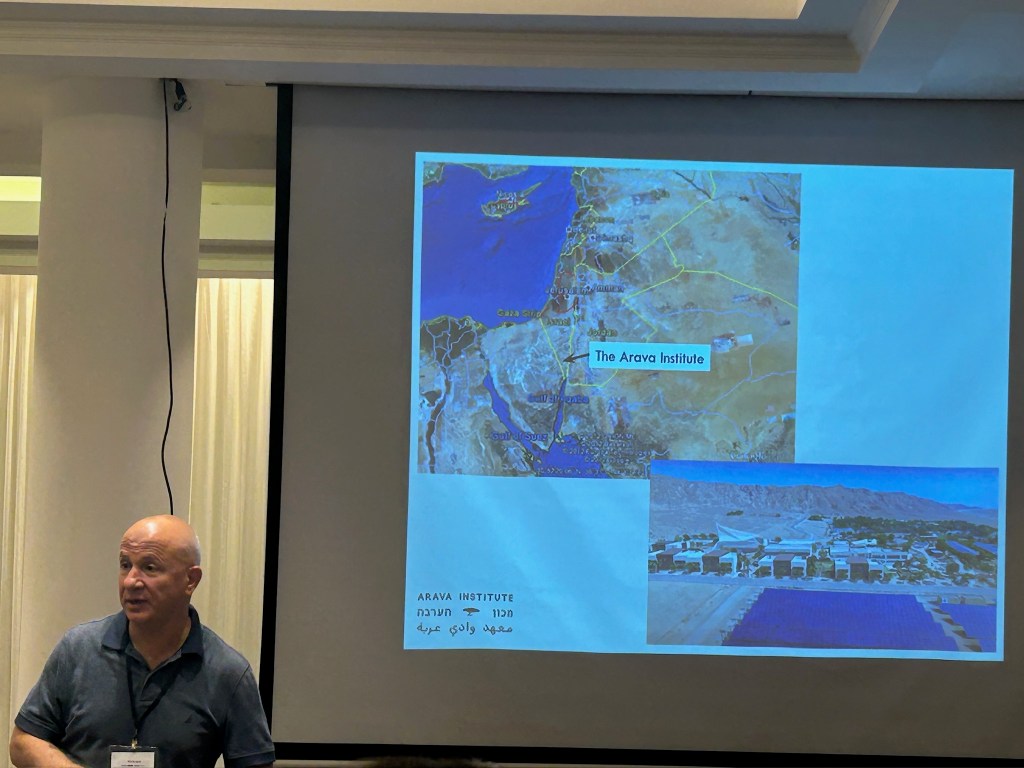
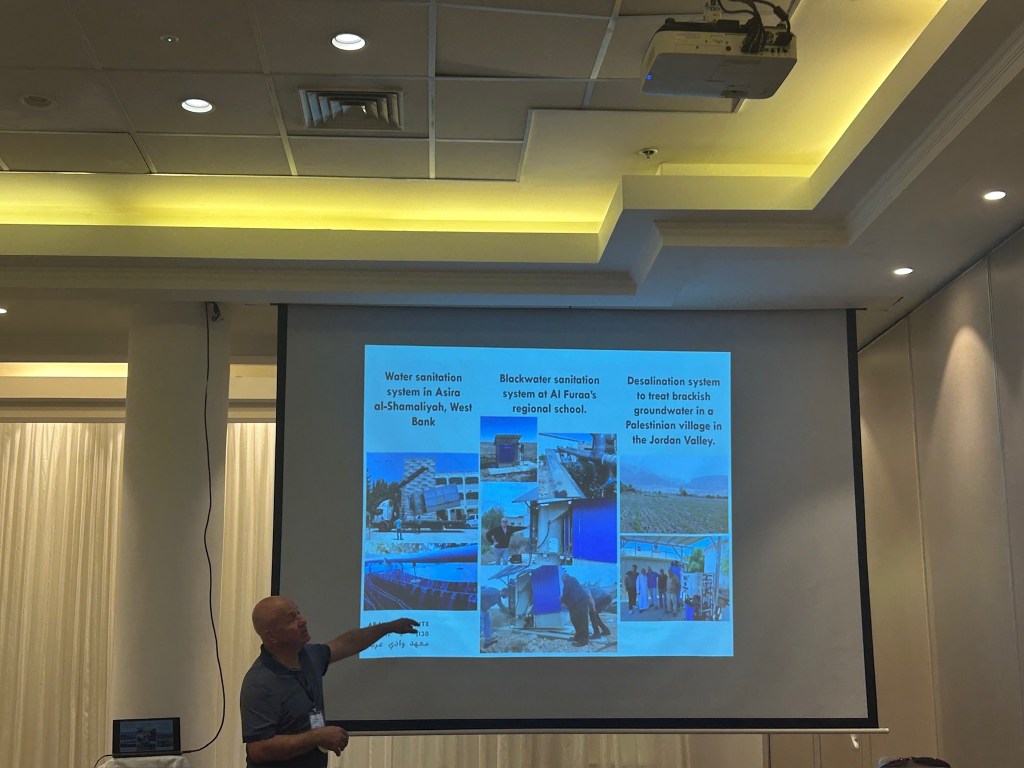
Tareq talked about the essential class provided to the college students over the semester called Dialogue Forum, during which the 1/3 Arab speakers, 1/3 Israeli Jews, and 1/3 International students come together in community and live on the kibbutz, sharing their histories and their stories. They also convene 2,000 alumni in the region annually and have not lost any since October 7th. They also have not lost a single regional partner.
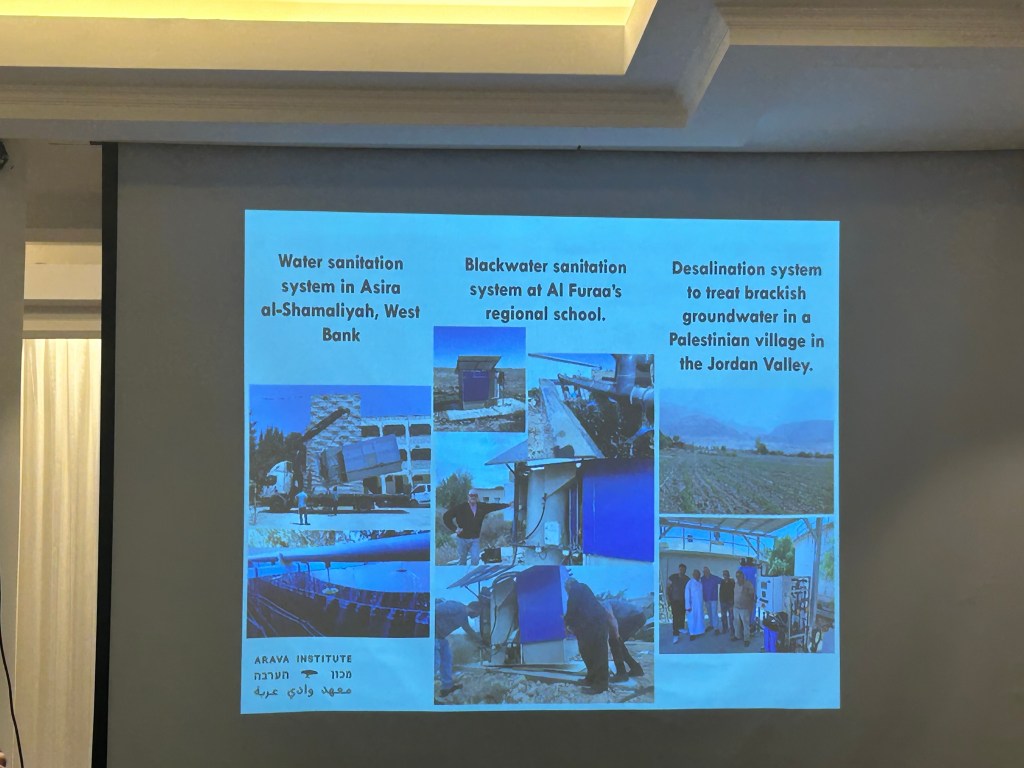
In describing the projects pictured in the slides, above (that is Tareq in the first photo), he shared that 70% of the West Bank, for example, is not connected to a sewage system. Their work includes connecting sewer systems which refine water that can be used for agriculture, and also serves as a demonstration project for much of the developing world that does not have formal sewage systems. He also mentioned that their long-term vision is to be a mecca of environmental solutions and diplomacy through the Middle East and Northern Africa. (Maybe next year we will visit their work in Morocco!)
One of these projects takes place in an “unrecognized” school, usually referring to a Bedouin community disconnected from electricity or water. They provide schools with this technology in part to encourage kids to be curious about science and get more involved.
Complementing the featured technologies, the Arava Institute developed a comprehensive training course for leading teachers and students to ensure proficiency in managing and operating the off-grid school system. The Institute also designed an environmental curriculum that will support the school’s transformation as a model center for climate education in the Negev-Naqab region.
The project caught the attention of the President of Israel, who made an unprecedented first visit to an unrecognized school.
Tareq also noted that when they design projects for communities in the region, they invite groups to approach them with problems and design solutions together, rather than developing solutions and then approaching communities with their ideas of what their problems might be and pre-determined solutions for them.
More about the project: https://arava.org/arava-research-centers/center-for-transboundary-water-management/al-furaa-off-grid-hub/
He also discussed the work they have done in Gaza over the past ten years identifying problems with sewage leaking into the ocean, lack of electricity, and contaminated water. Working with regional leaders who visited Kibbutz Keturah, home of the Arava Institute, they developed “green shelters” which provided thousands of people with safe, stable living areas during the war. The Palestinians named the shelter area after Vivian Silver, a Canadian peace activist who was killed by Hamas on October 7th.
https://www.bbc.com/news/world-middle-east-67413993
Ms Silver, born in Winnipeg, Manitoba, was one of Israel’s best known advocates for peace with the Palestinians. Her movement, Women Wage Peace, was established to pressure Israeli Prime Minister Benjamin Netanyahu’s government to reach a peace agreement to end the Arab-Israeli conflict.
Tareq also described the impact of the war on the current class of students. Usually they host 60 students per semester Right now they only have 30 students, as Palestinians from outside of Israel are not allowed to attend, and only 3 American students have been approved by American universities that site risk issues as the reason for denying their participation.
His final thoughts included the impact of US AID cuts to funding. The Institute has lost 25% of their funding, which luckily has been replaced by EU funding. Their regional partners, however, have lost up to 75% of their funding which has not yet been recovered.
We ended the day with dinner at 7:30 and admonitions to be sure to arrive at the bus at 6:45am the following day. We have to end the ride an hour before sunset which means we will be starting early! And you know how much the Chicago Boss Girls love an early morning wake-up call. But we will make all of you proud and show up on time ready to ride.
Much love, Sarah and Jackie
 A better future
Leave a comment