Overall purpose of our trip: To see a fuller picture, to understand the complexity of the story, and to have hope.
We met with Dr. Tareq Abu Hamed, executive director of the Arava Institute.
On our way to the meeting, the news broke that the team of investigators had just been nominated for a Nobel Peace Prize (we wouldn’t find out until October 11 if they win!!!)
Funny personal note. As we were gathering, our guide went to procure some coffee. We were chit-chatting and it occurred to me to ask if Tareq knew anyone at UC Davis. I had a vague recollection of my friend Yael giving us recommendations for the trip I was planning to go on next year with my friend Leah, and mentioning an environmental institute. I asked Tareq if he knew Yael at UC Davis. He responded, Yael Terf-Seker? Yes I replied. Yes, she is connected to his institute. They are friends! So of course I had to text her a photo of us together.
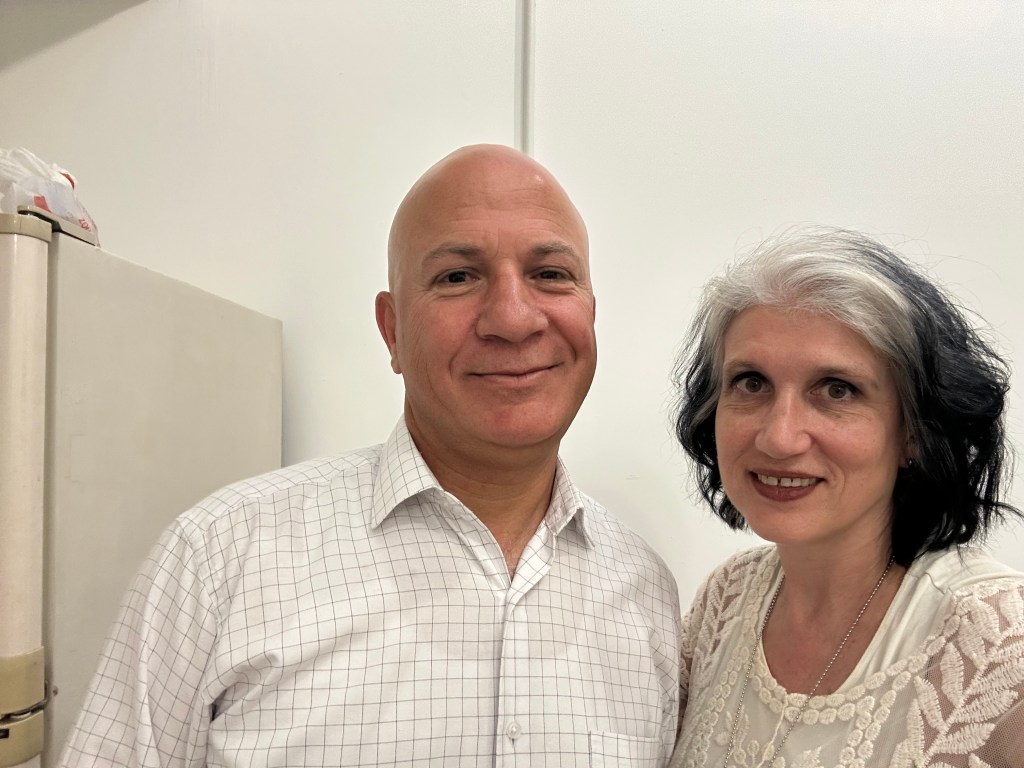
Look who I found in Jerusalem.
Her reply to my text:
“Wow!!! Say a big hi from me 🙂 This is one of my favorite people in the world. He is going to save the world. Or get close.
Vision from the Arava Institute website: “Here, the idea that nature knows no political borders is more than a belief. It is a fact, a curriculum, and a way of life.”
A bit about his story and his journey: he left the country during the first Intifada and went to Turkey.
https://www.history.com/this-day-in-history/intifada-begins-on-gaza-strip
Tareq also studied at a solar energy lab for 2 years in Minneapolis.
In 2008 he established the Arava Institute.
“You can’t allow political conflict to keep academics and scientists from collaborating to solve regional environmental problems.” If the groundwater is polluted in Gaza or the West Bank, it pollutes the water table that everyone shares.
“The Arava Institute undertakes cutting-edge research around transboundary issues and opportunities that intersect with related fields of environmental concern.” Every aquifer has shared groundwater. In essence, the vast majority of water recharge zones in the east lay entirely or almost entirely (80%) in the West Bank, although the largest storage areas lie within Israel. The western aquifer flows down the west coast of Israel with the bottom of the basin located in Gaza.
https://en.wikipedia.org/wiki/Water_supply_and_sanitation_in_Israel#Groundwater
This idea of Environmental Diplomacy was new to us, and we were captivated.
Tareq described how they structure their semesters for grad students. They construct a class with ⅓ Arabic students (Palestinisans and Israelis), ⅓ Jewish Israelis, and ⅓ International students. Often the Jewish Israelis are BFIs, “Back from India”, referring to the gap year they take between high school and military service.
The idea is that students can come to the Arava Institute for a semester to decide what they want to study long-term. This is one thing that makes their work unique with Palestinians, Jewish Israelis, and international students. It is a course and an opportunity to get to know each other and build relationships during a semester and not just a weekend or a few weeks.
In addition to science and engineering classes, the students also participate in a semester-long “Peace-Building Leadership Seminar” in which they share personal experiences living in Gaza, serving in the army, etc. They purposefully wrestle with tough questions in conversations with 3 facilitators. Jewish, Palestinian, and international students go to the same classrooms, sleep in the same dorms, eat in the same cafeteria, live together for four months and through this create understanding which leads to trust. [remember that conversation years ago with Oded about peace, trust and hope?]
“We believe the lack of trust and understanding brought us to this situation.”
Tareq relayed: “We use the research as a diplomacy tool–we often disagree with each other but at least there is understanding.”
Example: One day we went to Yad VaShem, the Holocaust Memorial in Jerusalem. Gabriella, one of the students, offered to give one of the Gazan students a personal tour. He said after: “Now I understand why you needed the State of Israel.” We have an alumni network of 2,000 students, we have an annual conference….
“Right after October 7th, the students chose to continue the semester. Even though some of the Israeli students were called in to serve in Gaza, and we helped some of the Gazan students evacuate to other countries…Israeli students from last semester were calling their friends in Gaza to see if they were safe, Gazan students were telling Israeli students going to serve to be safe…Tareq witnessed their shared understanding and relationships they had built, even if they don’t always agree. This was the power of getting to know each other as people with their own stories.”
In terms of the environmental projects and work that they do:
They built the first off-the-grid school that was completely solar. They built a school in a Bedouin community, where all of the toilets connected to a wastewater treatment plant, and recycled water is used for a community garden. Bedouin communities have been early adopters of solar with batteries for storage because they are not even on the grid.
They built seven projects in Gaza, with atmospheric water generators that are able to produce water from thin air. One of their projects is a sustainable refugee camp. The smallest one generates 1,000 liters of water per day and costs $100,000 to set up from off-the-shelf parts. Over five years, the average cost is 2 cents a liter, and the lifespan is about eighteen years.
According to Tareq, they didn’t lose any Arab partners after October 7th. They actually received more requests from new partners. They also sent a wastewater treatment plant in addition to the drinking water generators, which produces water women use to grow animal feed. They have been going there since December 2023.
Now they are trying to create small water generators for cars. This could have a huge positive impact on the environment to reduce plastic bottles.
Final thoughts after October 7th: Rebuilding Gaza will take years. Via a network of organizations they are building in reaction to the conflict, they have plans to send in off-the-grid technology to help meet people’s basic needs. Organizations they partner with include Water to the World, Central Kitchen projects, Greenpeace, Engineers without Borders, etc.
The goal for Tareq is to keep channels open and ensure that both sides are willing to keep talking. They are seeing major trauma now and have to figure out how they can convince each side to keep talking to the other side.
1.5 million people in Gaza are under the age of 30.
The vast majority on both sides want to live in peace. “The problem is we don’t know each other.” According to Tareq, he observed that prior generations knew each other. This is similar to what we heard at Kibbutz K’far Azza before Hamas. They went to the beach in Gaza, had friends, Gazans came to the Israel to buy produce. This government has disconnected the two communities.
Tareq’s personal story:
He grew up in East Jerusalem. During the first Intifada at 16 he wanted to strengthen his English so he went to the Kibbutz, which was his first interaction with Jewish neighbors. The Arava Institute was looking to establish a Center on a Kibbutz. His was the 1st Arab family who lived on the kibbutz.
They saw a lot of conflict in East Jerusalem, and received a lot of criticism from both sides.
“Climate Change is a global problem, it brings people together through a global language. It should be normal to have a place in your heart for both countries.”
Someone asked him the question:
What does it mean to be a Palestinian citizen of Israel?
“My wife is an Arabic teacher and couldn’t find a job on the kibbutz in the south. So we moved back to East Jerusalem.
I became the acting chief scientist at The Ministry of Science, Technology and Space, representing the Israeli government. During one of my many trips to the OECD office in Europe, I was treated particularly badly at the airport in Tel Aviv for being Palestinian. During the conference, I was asked, are you an Arab? And when I replied yes, they noted how beautiful it was that I was representing Israel. On my return, I told the Minister I wasn’t going to represent Israel any more.
As a Palestinian, you are a resident, not a citizen. I had a Jordanian passport. I couldn’t vote for the Knesset. I had to pay taxes, but I could only vote for the Palestinian government in the West Bank. You are treated as a second-class citizen; infrastructure, education, social welfare, health care, etc. are all very inferior. Eventually I applied for Israeli citizenship and got it. As a citizen you can serve in the army but you don’t have to.
In the past, it was hard to get a job in many places as a Palestinian. You couldn’t work in security, as a pilot or a flight attendant…More recently you have started seeing Arabs/Palestinis in high positions in the Israeli Social Sector, such as Ministers, heads of hospitals. 70% of people in hospitals are Arabs.
Once you feel you don’t have equal rights, you seek independence. Israel started having quotas, similar to affirmative action. 20% of people employed must be Arab. You started seeing Arab Israelis going into other political parties that were not only based on being Arab.”
He left us with an incredible feeling of hope, with the ability to imagine how environmental diplomacy and learning each others’ stories, combined with a sense of justice, could change the story for generations to come.
 A better future
Leave a comment